
Antigua Guatemala
안티과 과테말라
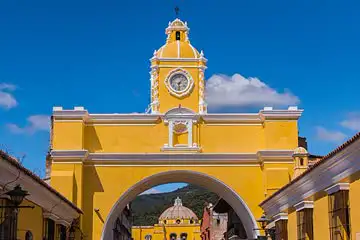
Antigua Guatemala, usually called just Antigua, is a city in the central highlands of Guatemala. Its name means "Old Guatemala". It was the capital of the Captaincy General of Guatemala from 1543 to 1773, and much of the city's Baroque-influenced look and layout comes from that time. In 1979 UNESCO named it a World Heritage Site because of its Spanish Baroque architecture, its street plan, its churches and its ruins.
See it on the 3D globe →At a glance
- Country
- Guatemala
- Location
- Antigua Guatemala, Guatemala
- Built
- 1543
- Type
- Historic district
Quick answers
Where is Antigua Guatemala?
Antigua Guatemala is in Antigua Guatemala, Guatemala.
When was Antigua Guatemala built?
Antigua Guatemala was built in 1543.
The old colonial capital beneath Volcán de Agua, with the yellow Santa Catalina Arch and its Baroque churches.
Its colonial name was Santiago de los Caballeros de Guatemala, after Saint James, the city's patron saint. The streets run in a neat grid around a central square, with the church and government buildings around the plaza. Today Antigua is known for the ruins of its earthquake-damaged churches, its Spanish language schools, and for elaborate processions during Lent and Holy Week.
A capital that kept moving
The first capital was founded in 1524 near the Kaqchikel Maya city of Iximche. After Kaqchikel uprisings, it moved in 1527 to the Valley of Almolonga. In 1541 that city was destroyed by a lahar, a flood of mud, from the Volcán de Agua. So on 10 March 1543 the Spaniards founded the city again, eight kilometres to the north in the Panchoy Valley, which is today's Antigua. For about 230 years it governed a huge area that included today's Guatemala, Belize, El Salvador, Honduras, Nicaragua and Costa Rica, plus the Mexican state of Chiapas.
Earthquakes
Antigua sits in a zone of earthquakes and volcanoes. Several quakes in the 16th century damaged it, and the San Miguel earthquakes of 1717 hurt the city so much that officials thought of moving it. Residents protested, and the city stayed. Then the San Casimiro earthquake of 4 March 1751 destroyed it again. The capital finally moved in 1776 to a new city, and many of Antigua's churches and convents were left as the ruins visitors see today.
Antigua today
Antigua is one of the places in the world known for learning Spanish through immersion, with many language schools. During Lent, each Sunday a local parish holds a procession, and the streets are covered in carpets made of dyed sawdust, flowers, pine needles and even fruit and vegetables. The National Museum of Guatemalan Art is housed in the old Palace of the Captaincy General.
Fun facts
- It was Guatemala's capital until earthquakes in 1773 led to a move.
- Its name means "Old Guatemala" and it was once the capital of lands from Chiapas to Costa Rica.
- In 1566 King Philip II of Spain gave the city the title "Very Noble and Very Loyal".
- During Lent, processions walk over carpets made of dyed sawdust, flowers and even fruit.
- It was the third capital of Guatemala, after two earlier cities were moved or destroyed.
On the globe
The model shows the old colonial town with the yellow Santa Catalina Arch and Baroque churches beneath a volcano.
Quiz time
Which is older: Antigua Guatemala or Statue of Liberty?
Show the answer
Antigua Guatemala. (1543 vs 1886) Statue of Liberty →
Nearby on the globe

Sources
Updated: 2026-10-14