
Avenue of the Baobabs
바오바브 거리
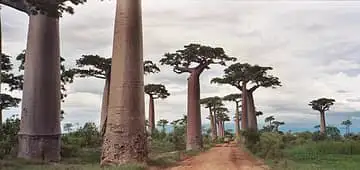
The Avenue of the Baobabs is a stretch of dirt road in western Madagascar, lined with enormous baobab trees. It lies on the road between the town of Morondava and Belon'i Tsiribihina, in the Menabe region. Along about 260 metres of road stand some 20 to 25 giant trees, and about 25 more grow in the nearby rice fields and meadows. The trees reach around 30 metres high, like a ten-storey building.
See it on the 3D globe →At a glance
- Country
- Madagascar
- Location
- Morondava, Madagascar
- Height
- 30 m
Quick answers
Where is Avenue of the Baobabs?
Avenue of the Baobabs is in Morondava, Madagascar.
How tall is Avenue of the Baobabs?
Avenue of the Baobabs is about 30 m tall.
A dirt road lined with towering baobab trees, some centuries old, especially striking at sunset.
The trees are Grandidier's baobabs, a species found only in Madagascar. People in Madagascar call them renala or reniala, which means "mother of the forest". Their thick, smooth trunks carry only a small crown of branches at the very top. The avenue is one of the most visited places in the region, and photographers from all over the world come here, especially around sunset.
Why are the trees standing alone?
The baobabs did not always stand alone in an open landscape. Long ago they grew inside a thick tropical forest. As more people came to live in the area, the forest was cut down to make room for farms and rice fields. The local people kept the baobabs, partly because they valued the trees themselves and partly because the trees gave them food and building materials. So today the giants rise above fields and scrub, as reminders of the forest that once surrounded them.
The amazing baobab tree
A Grandidier's baobab has a huge, cylinder-shaped trunk that can be up to 3 metres across, covered in smooth, reddish-grey bark. Its white flowers open around dusk and are said to smell like sour watermelon. At night, fork-marked lemurs and hawk moths visit the flowers to drink nectar and carry pollen from tree to tree. The large round fruits ripen in November and December. People eat the vitamin-rich pulp and seeds, and squeeze cooking oil from the seeds.
Protecting the avenue
Grandidier's baobab is an endangered species, threatened as farmland spreads into its home. The avenue was given temporary protection in July 2007, a step toward making it Madagascar's first natural monument, and a local conservation group called Fanamby helps look after the area. It has planted young baobabs nearby, protected by small fences. The trees still face dangers such as forest clearing, bushfires and water running in from nearby rice fields.
Fun facts
- Some of the trees are thought to be up to around 800 years old, although the exact age of a baobab is hard to measure.
- The local name reniala comes from Malagasy words meaning "mother of the forest".
- A few kilometres away stand the "Baobabs in Love", two baobabs of another species that grew twisted around each other.
- Scientists have never seen any animal spread this baobab's seeds; today, water may carry them instead.
On the globe
The model shows tall baobab trees with thick bare trunks and small flat crowns lined up along a dirt road. Zoom in on western Madagascar to walk down the avenue between the giants.
Quiz time
Which is taller: Avenue of the Baobabs or Le Morne Brabant?
Show the answer
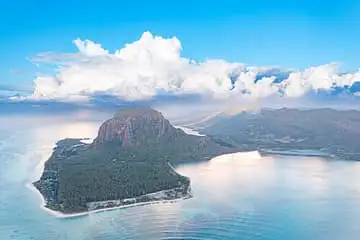
Le Morne Brabant. (30 m vs 556 m) Le Morne Brabant →
Nearby on the globe

Sources
- Read more on Wikipedia
- Avenue of the Baobabs — Wikipedia
- Adansonia grandidieri — Wikipedia
- Avenue of Baobabs — MadaMagazine
Updated: 2026-10-13