
Great Zimbabwe
그레이트 짐바브웨 유적
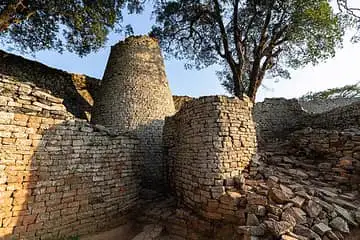
Great Zimbabwe is the ruins of a large medieval stone city in the hills of south-eastern Zimbabwe, near the town of Masvingo in southern Africa. Ancestors of today's Shona people built it, and it grew into the capital of a rich kingdom. Most of its stone buildings went up between the 11th and 15th centuries, and its granite walls were made without any mortar, the cement-like paste usually used to stick stones together.
See it on the 3D globe →At a glance
- Country
- Zimbabwe
- Location
- Masvingo, Zimbabwe
- Built
- 11th–15th c.
- Height
- 11 m
- Type
- Ancient site
Quick answers
Where is Great Zimbabwe?
Great Zimbabwe is in Masvingo, Zimbabwe.
How tall is Great Zimbabwe?
Great Zimbabwe is about 11 m tall.
Ruins of a medieval city built of mortarless stone walls; the country takes its name from it.
Its stone city covers about 7 square kilometres, and it became a UNESCO World Heritage Site in 1986. The site is so important to the people of Zimbabwe that the country took its name from it: "Zimbabwe" is a Shona word often explained as "houses of stone". A soapstone bird carving found in the ruins now appears on Zimbabwe's national flag.
History
People were living at Great Zimbabwe by about the year 1000, and the city was at its strongest from about 1300 to 1450. It grew rich by trading gold and ivory with ports on the Swahili coast of East Africa, which were part of a huge trade network across the Indian Ocean. Archaeologists have found Chinese porcelain, Persian objects, glass beads and Arab coins there. By the 15th and 16th centuries the city was being abandoned; nobody knows exactly why, but running out of gold, farmland and water may all have played a part.
How it was built
The city has three main parts. The Hill Complex, on top of a rocky hill, is the oldest. The Great Enclosure, in the valley below, is a huge oval wall up to about 11 metres high and about 250 metres around. Inside it stands a stone Conical Tower about 9 to 10 metres tall, whose purpose is still a mystery. The Valley Complex held more homes. Builders shaped granite blocks and stacked them so carefully that the walls have stood for hundreds of years without any mortar.
Myths and the truth
When European explorers saw the ruins in the 1800s, some refused to believe that Africans had built them. They invented stories linking the city to King Solomon, the Queen of Sheba or traders from far away. The colonial government even pressured archaeologists to support these ideas. But careful research proved that the city was built by local African people, the ancestors of the Shona, and by the 1950s scholars agreed on this.
Fun facts
- Its walls were built from stone without any mortar.
- The walls of the Great Enclosure are up to 5.5 metres thick, as wide as a small room.
- Eight carved soapstone birds were found at the site, and one of them is pictured on Zimbabwe's flag.
- The whole city was built of stacked granite blocks, with no mortar holding them together.
- Pieces of Chinese porcelain dug up at Great Zimbabwe show that its trade reached all the way across the Indian Ocean.
On the globe
The model shows the ruins of Great Zimbabwe with its walls of stacked stone. Zoom in to see how the walls are built from layers of stone blocks without any mortar.
Quiz time
Which is taller: Great Zimbabwe or Victoria Falls?
Show the answer
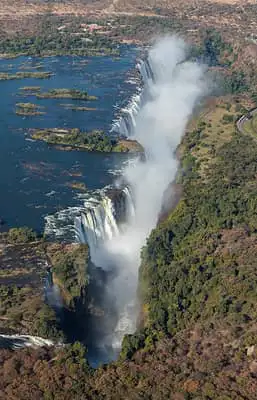
Victoria Falls. (11 m vs 108 m) Victoria Falls →
Nearby on the globe


.jpg)
Sources
- Read more on Wikipedia
- Great Zimbabwe — Wikipedia
- Great Zimbabwe — National Geographic Education
- Great Zimbabwe — World History Encyclopedia
Updated: 2026-10-13