
Baikonur Cosmodrome
바이코누르 우주기지
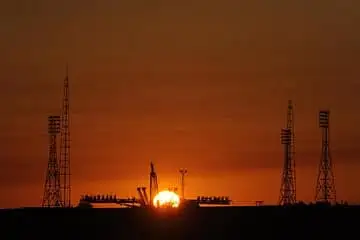
The world's oldest and largest space launch facility, on the Kazakh steppe and leased by Russia. From Site 1, 'Gagarin's Start', Yuri Gagarin left for orbit in 1961; its last launch was in 2019, and it is to become a museum. Its pad has two folding service cabins, a flame trench and lightning masts, while rockets are rolled out by rail from the MIK assembly building.
See it on the 3D globe →At a glance
- Country
- Kazakhstan
- Location
- Baikonur, Kyzylorda Region, Kazakhstan
- Built
- 1955
- Height
- 80 m
- Type
- Infrastructure
Quick answers
Where is Baikonur Cosmodrome?
Baikonur Cosmodrome is in Baikonur, Kyzylorda Region, Kazakhstan.
When was Baikonur Cosmodrome built?
Baikonur Cosmodrome was built in 1955.
Baikonur Cosmodrome is a spaceport on the Kazakh steppe, in Kazakhstan, run by Russia. It was founded in 1955 and is the largest operational space launch facility in the world by area. Every Russian crewed spaceflight has lifted off from here, and so did the first satellite, Sputnik 1, in 1957, and the first human in space, Yuri Gagarin, in 1961.
The site sits about 90 metres above sea level, 200 kilometres east of the Aral Sea and 33 kilometres north of the Syr Darya river. It was built as the main base of the Soviet space programme and still launches many crewed, commercial, military and scientific missions. Russia rents it from Kazakhstan under an agreement that runs until 2050. The launch pad used for Sputnik and Gagarin's flight is known as Gagarin's Start.
Why here?
In 1955 a commission led by General Vasily Voznyuk chose the village of Tyuratam, with advice from the chief designer Sergey Korolyov. The land had to be flat, because the rocket's radio control needed unbroken signals from ground stations hundreds of kilometres away. The rockets also had to fly away from towns, and a southern location helps because the ground moves faster near the equator. Building the pads, new roads and railways made it one of the most expensive projects of the Soviet Union, and a town for workers grew nearby.
Famous firsts
Many historic flights began here. Sputnik 1, the first artificial satellite, went up on 4 October 1957. Luna 1, the first spacecraft to pass close to the Moon, flew in January 1959. Yuri Gagarin made the first crewed orbital flight on 12 April 1961, and Valentina Tereshkova, the first woman in space, flew in 1963. Fourteen cosmonauts from 13 other nations, including India and France, also launched from Baikonur. Venera 9 and Mars 3 started their journeys here too.
Today and the name
Baikonur is the only spaceport from which Russian missions to the International Space Station launch, and the station's orbit tilt of 51.6 degrees was chosen partly because of where the site is. The final launch from Gagarin's Start took place on 25 September 2019, and in 2023 officials said they planned to turn it into a museum. The name Baikonur was reportedly picked in 1961 to mislead outsiders, since a small mining town of that name lies about 320 kilometres away, though NASA's history says it was an old local name.
Fun facts
- Sputnik 1 in 1957 and Yuri Gagarin in 1961 both launched from here.
- Russia pays about 115 million US dollars a year to rent the cosmodrome, a price that has stayed fixed for years.
- When American astronauts toured the site in 1975, Thomas Stafford said it made Cape Kennedy look very small.
- The closed city built for the cosmodrome was called Leninsk until it was renamed Baikonur in 1995.
- The first American U-2 spy plane photo of the missile range was taken on 5 August 1957.
On the globe
The model shows the launch pad with its service cabins and lightning masts. Look for the rail track from the assembly building.
Quiz time
Which is older: Baikonur Cosmodrome or Registan, Samarkand?
Show the answer
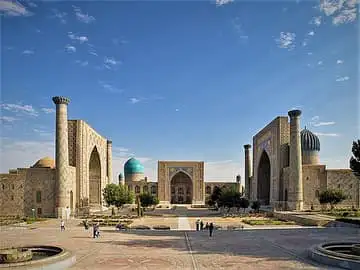
Registan, Samarkand. (1955 vs 1660) Registan, Samarkand →
Nearby on the globe

Sources
Updated: 2026-10-14