
Chhatrapati Shivaji Maharaj Terminus
차트라파티 시바지 마하라지 터미너스
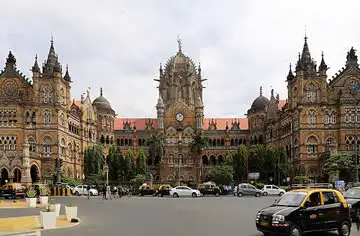
Chhatrapati Shivaji Maharaj Terminus, usually called CST or CSMT, and long known as Victoria Terminus (VT), is a historic railway station and UNESCO World Heritage Site in Mumbai, India. It was designed by the British engineer Frederick William Stevens, working from a watercolour by the draughtsman Axel Haig, in a rich Indo-Gothic style. It was built between 1878 and 1887, the year of Queen Victoria's Golden Jubilee, and opened to the public on 20 May 1888.
See it on the 3D globe →At a glance
- Country
- India
- Location
- Mumbai, India
- Built
- 1888
- Type
- Infrastructure
Quick answers
Where is Chhatrapati Shivaji Maharaj Terminus?
Chhatrapati Shivaji Maharaj Terminus is in Mumbai, India.
When was Chhatrapati Shivaji Maharaj Terminus built?
Chhatrapati Shivaji Maharaj Terminus was built in 1888.
Mumbai's great railway terminus, fusing Victorian Gothic Revival with Indian motifs under a soaring central dome.
It is the headquarters of India's Central Railway and one of the busiest stations in the country, with 18 platforms: seven for suburban trains and eleven for long-distance trains. Its name was changed in 1996 to honour Shivaji, the 17th-century founder of the Maratha Empire, and in 2017 the title Maharaj, meaning great king, was added. People still use all of the names VT, CST and CSMT.
A palace for trains
The station replaced the old Bori Bunder station, which had been the terminus of the Great Indian Peninsular Railway from 1853 to 1888. Bombay was becoming a major port city and needed something bigger. The design is often compared with St Pancras station in London, but it is closer to another design with many towers and a big ribbed dome. It took ten years to build, the longest for any building of its time in Mumbai.
Decoration and engineering
The main structure combines Indian sandstone and limestone, with fine Italian marble for key decorations. The gates are flanked by a lion for Britain and a tiger for India. Allegorical statues stand for Commerce, Agriculture, Engineering and Science. Students of the Sir J. J. School of Art, guided by John Lockwood Kipling, carved much of the decoration. The dome rests on dovetailed ribs built without temporary support, a clever feat for its day.
The missing statue and a modern glow
A marble statue of Queen Victoria once stood under the clock on the front. In the 1950s British statues were removed from public places, and Victoria's statue vanished. The figure on top of the dome, often mistaken for the queen, is actually a symbol of Progress. Since 2022 the building has been lit with colourful LED lights in the evening, changing for national holidays and festivals.
Fun facts
- It was first named Victoria Terminus, after Queen Victoria.
- It took ten years to build, the longest for any building of its era in Mumbai.
- The gates are guarded by a lion for Britain and a tiger for India.
- The statue on top of the dome is a symbol of Progress, not Queen Victoria.
- It has 18 platforms: seven for suburban trains and eleven for long-distance trains.
On the globe
The model shows the railway station with its stone facade and central dome.
Quiz time
Which is older: Chhatrapati Shivaji Maharaj Terminus or Gyeongbokgung Palace?
Show the answer
Gyeongbokgung Palace. (1888 vs 1395) Gyeongbokgung Palace →
Nearby on the globe

Sources
Updated: 2026-10-14