
Golconda Fort
골콘다 요새
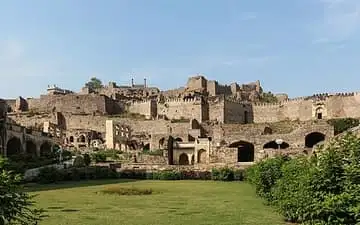
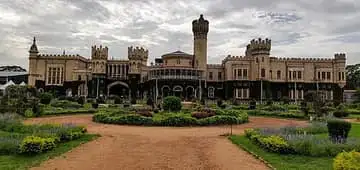
A citadel on a 120 m granite hill west of Hyderabad, greatly fortified by the Qutb Shahi dynasty in the 16th century. Crenellated walls with round bastions ring the boulder-strewn hill, crowned by the Bala Hissar pavilion.
See it on the 3D globe →At a glance
- Country
- India
- Location
- Hyderabad, India
- Built
- 13th century; fortified from 1518
- Height
- 120 m
- Type
- Fort
Quick answers
Where is Golconda Fort?
Golconda Fort is in Hyderabad, India.
Golconda Fort is a granite citadel on a hill in the western part of Hyderabad, Telangana, India. It began as a small mud fort in the 11th century and was greatly expanded in the 1500s by the Qutb Shahi sultans of Golconda into a huge fortress about 5 kilometres around, with an outer wall of roughly 7 kilometres that once enclosed a whole city.
Golconda was famous as a trading centre for large diamonds, since diamonds from nearby mines such as Kollur were traded here. The Koh-i-Noor and the Hope diamond are said to have come from mines in this region.
From mud fort to capital
The name Golconda probably comes from the Telugu words for "shepherd's hill". Rulers of the Kakatiya dynasty built the first fort, and it later passed to the Bahmani sultans. In 1518 Quli Qutb Shah made himself independent and turned it into the capital of the Sultanate of Golconda. Over 62 years the first three Qutb Shahi sultans rebuilt the mud fort in granite. The capital moved to Hyderabad in 1590, but Golconda stayed important as a fortress.
Sound and stone
The walls have round bastions, and a pavilion called Bala Hissar crowns the boulder-strewn hill about 120 metres high. The fort is famous for its clever acoustics: a clap made under the entrance dome is said to be heard at the top of the hill. In 2014 Golconda and other forts were put on UNESCO's tentative list for World Heritage status.
Fun facts
- A handclap under its entrance dome can be heard at the top of the hill.
- A clap under the entrance dome can reportedly be heard at the top of the hill.
- Golconda's name probably means "shepherd's hill".
- The outer wall is about 7 kilometres long.
- The fort was rebuilt from mud to granite in about 62 years.
On the globe
The model shows the walled citadel with round bastions on its granite hill.
Nearby on the globe



Sources
Updated: 2026-10-14