
Ajanta Caves
아잔타 석굴
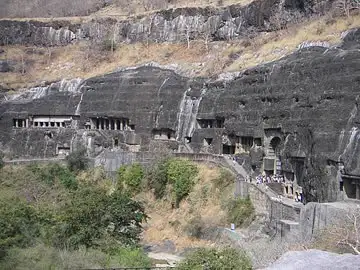
The Ajanta Caves are about 30 Buddhist caves carved into a rock wall in Maharashtra state, India. They date from the second century BCE to about 480 CE and are a UNESCO World Heritage Site. They are famous as masterpieces of Buddhist art, with wall paintings and carved sculptures described as among the finest surviving examples of ancient Indian art.
See it on the 3D globe →At a glance
- Country
- India
- Location
- Maharashtra, India
- Built
- 480
- Type
- Religious building
Quick answers
Where is Ajanta Caves?
Ajanta Caves is in Maharashtra, India.
When was Ajanta Caves built?
Ajanta Caves was built in 480.
About 30 Buddhist caves cut into a horseshoe-shaped gorge, preserving masterpieces of ancient Indian painting.
The caves are monasteries (viharas) and worship halls (chaityas) cut into a 75-metre wall of rock on the northern side of a U-shaped gorge of the River Waghur, in the Deccan Plateau. The paintings show the past lives and rebirths of the Buddha, and Caves 1, 2, 16 and 17 hold the largest collection of surviving ancient Indian wall paintings. The expressive figures show feelings through gesture, pose and form.
Two stages of building
The caves were made in two phases. The first group, caves 9, 10, 12, 13 and 15A, belongs to about the second century BCE and the years after. Most of the rest were made later, from the fifth century. Older accounts say this took place from 400 to 650 CE, while the scholar Walter Spink argued that most of the work was done in a short time between 460 and 480 CE under the Vakataka emperor Harishena. Other scholars disagree and argue for a longer period.
Monks, merchants and pilgrims
Written records suggest the caves served as a monsoon retreat for monks, and as a resting place for merchants and pilgrims. The Chinese pilgrim Faxian recorded Buddhist pilgrims visiting around 400 CE, and several medieval Chinese travellers mention the caves. Later the caves were covered by jungle.
Found by chance
In 1819 a British officer, Colonel John Smith, came across the caves during a tiger hunt and they were "discovered" for the wider world. Numbers were given to the caves from 1 to 29, but later finds added more, such as Cave 15A. Visitors today come from Jalgaon, about 59 kilometres away, or from Aurangabad, 104 kilometres away. The nearby Ellora Caves, another World Heritage Site, share a similar style.
Fun facts
- The caves were cut into a rock wall 75 metres high above a river gorge.
- They were covered by jungle until a tiger-hunting party found them in 1819.
- Caves 1, 2, 16 and 17 hold the largest collection of surviving ancient Indian wall paintings.
- In the gorge, waterfalls can be heard from outside the caves when the river is high.
On the globe
The model shows the horseshoe-shaped gorge with the row of cave entrances carved into it.
Quiz time
Which is older: Ajanta Caves or Kailasa Temple, Ellora?
Show the answer
Ajanta Caves. (480 vs 770) Kailasa Temple, Ellora →
Nearby on the globe



.jpg)
Sources
Updated: 2026-10-14