
Grand Canyon
그랜드 캐니언
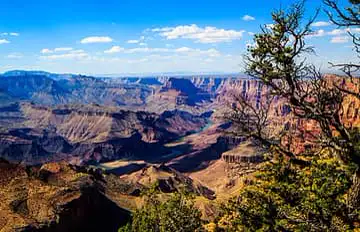
The Grand Canyon is a giant, steep-sided valley in Arizona, in the south-west of the United States. It was carved by the Colorado River and is about 446 kilometres long, up to 29 kilometres wide and more than 1.8 kilometres deep in places. Most of it lies inside Grand Canyon National Park, which became a national park in 1919.
See it on the 3D globe →At a glance
- Country
- United States
- Location
- Arizona, USA
- Height
- 1,800 m
Quick answers
Where is Grand Canyon?
Grand Canyon is in Arizona, USA, United States.
A mile-deep gorge carved by the Colorado River, exposing nearly two billion years of rock layers.
The canyon is famous for its colourful cliffs. Its walls are made of stacked rock layers, like the pages of a giant book, and together they show nearly two billion years of Earth's history. Native American peoples have lived in and around the canyon for thousands of years, and the Pueblo people treated it as a holy place. Its rocks are some of the best-preserved records of early North American history anywhere.
How the canyon formed
The story starts almost two billion years ago, when the dark rocks now found at the very bottom of the canyon were formed. Over a very long time, layer after layer of sand, mud and sea creatures settled on top. Then, between about 70 and 30 million years ago, slow movements of the Earth's crust pushed the whole region upward into a high, flat area called the Colorado Plateau. Starting about 5 to 6 million years ago, the Colorado River began cutting downward, while rain, ice and side streams widened the walls.
Reading the rock layers
Geologists read the canyon from the bottom up: the oldest rocks are at the bottom and the youngest are on top. The top layer, the Kaibab Limestone, actually formed on the floor of an ancient sea, yet today it sits as high as about 2,700 metres above sea level. The North Rim is roughly 300 metres higher than the South Rim, so it is cooler and gets more snow, and its road is closed in winter.
People and wildlife
The first European known to have seen the canyon was the Spanish explorer García López de Cárdenas, in 1540. President Theodore Roosevelt loved the area and helped protect it; it became a national monument in 1908. Today the park is home to mule deer, desert bighorn sheep, black bears and elk, and very rare California condors, giant vultures that were brought back to the region after almost disappearing, now soar over the eastern part of the park.
Fun facts
- It is 446 km long and up to 29 km wide.
- The rocks at the top of the Grand Canyon were once at the bottom of a sea.
- Some of the rocks at the canyon floor are almost two billion years old.
- The Grand Canyon is not the deepest canyon on Earth: the Kali Gandaki Gorge in Nepal is much deeper.
- The North Rim is about 300 metres higher than the South Rim, so the two sides have different weather.
On the globe
The model shows the canyon as eroded, step-like land with flat rock layers, standing buttes, side canyons and the Colorado River winding through the bottom. Zoom in to follow the river and count the coloured stripes in the walls.
Nearby on the globe


.jpeg)
Sources
- Read more on Wikipedia
- Grand Canyon — Wikipedia
- 그랜드 캐니언 — 위키백과
- Grand Canyon Geology — National Park Service
Updated: 2026-10-13