
Khami Ruins
카미 유적
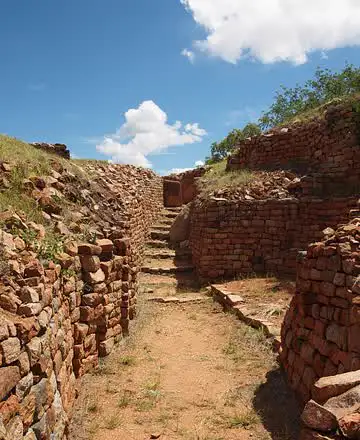
Khami is the ruin of a stone city about 22 kilometers (14 miles) west of Bulawayo in Zimbabwe. It was the capital of the Kingdom of Butua, ruled by the Torwa dynasty, and it was founded around 1450, at about the time the great city of Great Zimbabwe faded away.
See it on the 3D globe →At a glance
- Country
- Zimbabwe
- Location
- Near Bulawayo, Zimbabwe
- Built
- 1450
- Type
- Ancient site
Quick answers
Where is Khami Ruins?
Khami Ruins is in Near Bulawayo, Zimbabwe.
When was Khami Ruins built?
Khami Ruins was built in 1450.
Capital of the Torwa state after Great Zimbabwe, with dry-stone terraces decorated in chequered patterns.
The walls were built from carefully shaped stones laid without any mortar, and many are decorated with checkerboard, herringbone and cord patterns. Today Khami is a national monument and, since 1986, a UNESCO World Heritage Site. Its builders had to work with hard granite and dolerite stone that was difficult to cut, so they came up with a new way of building.
A city on platforms
The builders followed the style that began at Great Zimbabwe, but changed it to suit their land. Khami's stone is hard and splits into odd shapes, so the builders made retaining walls, which hold up earth like a terrace, instead of tall free-standing walls.
Houses stood on the flat platforms behind them. This made the houses cooler, and it also kept the royal family away from the mosquitoes of the river valley, which carried malaria.
Kings and what came next
The king lived in the Hill Complex, which was built from terraces of rough walling and then covered with neat, dressed stone. The site has seven built-up areas for the royal family, while ordinary people lived in the open valley below.
Khami was the Torwa capital for about 200 years. It was then conquered by Changamire Dombo and his Rozvi army, traditionally in 1683, and later Ndebele raiders drove people away in the 1830s.
Fun facts
- The walls at Khami are held together by their own weight, with no mortar.
- Platforms made the king's houses cooler and helped keep away malaria.
- Some stone blocks in the foundations were big enough to need at least four people to lift them.
- Khami became a UNESCO World Heritage Site in 1986.
On the globe
The model shows the terraced stone walls of Khami with their chequered decoration.
Quiz time
Which is older: Khami Ruins or Mapungubwe Hill?
Show the answer
Mapungubwe Hill. (1450 vs 1220) Mapungubwe Hill →
Nearby on the globe



Sources
Updated: 2026-10-14