
Hawa Mahal
하와 마할
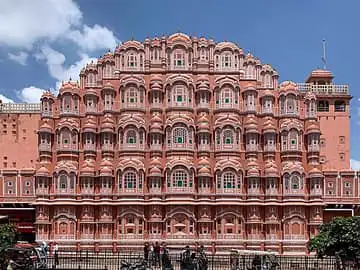
Hawa Mahal, the Palace of Winds, is a palace of red and pink sandstone in Jaipur, Rajasthan, India. It stands on the edge of the City Palace and reaches into the Zenana, the women's chambers. Maharaja Sawai Pratap Singh built it in 1799, and the architect was Lal Chand Ustad. Its honeycomb-like front, covered in small windows and balconies, has become a symbol of Jaipur.
See it on the 3D globe →At a glance
- Country
- India
- Location
- Jaipur, India
- Built
- 1799
- Height
- 15 m
- Type
- Palace
Quick answers
Where is Hawa Mahal?
Hawa Mahal is in Jaipur, India.
When was Hawa Mahal built?
Hawa Mahal was built in 1799.
How tall is Hawa Mahal?
Hawa Mahal is about 15 m tall.
The "Palace of Winds", a pink sandstone facade with 953 small latticed windows.
The five-storey building is shaped like a pyramid and rises to about 15 metres. Its front carries 953 small windows called jharokhas, each with carved lattice screens. The pink-red stone matches other monuments in the city and fits Jaipur's nickname, the Pink City. Many visitors think the street side is the front of the palace, but it is really the back.
Windows that breathe
The lattice windows had two jobs. They let the royal women watch daily life and street festivals without being seen from outside. They also worked as cooling vents: air moving through the narrow openings, helped by the Venturi effect, made the rooms more pleasant in the hot summers, and fountains in the centre of each chamber added to the cooling.
Inside and behind the wall
The real entrance is on the other side, through an imperial door from the City Palace that opens into a large courtyard. The top three floors are only one room wide, while the first and second floors have patios in front. The back of the building has plain chambers with pillars and corridors, which is a strong contrast to the richly carved front. The top two floors can be reached only by ramps. An archaeological museum is housed in the courtyard.
A mix of styles and a big repair
The design blends Hindu Rajput architecture, seen in domed canopies, fluted pillars and flower patterns, with Islamic Mughal touches such as arches and stone inlay. The palace is said to have been inspired by the Khetri Mahal. A major renovation was carried out in 2006 after a gap of about 50 years, and a company-backed programme adopted the monument to look after it.
Fun facts
- The palace has 953 tiny windows, called jharokhas.
- The famous street side is actually the back of the building.
- Its name is Persian for "wind palace".
- The top two floors can be reached only by ramps, not stairs.
On the globe
The model shows the pink front wall full of small windows. Look for the honeycomb pattern.
Quiz time
Which is taller: Hawa Mahal or Taj Mahal?
Show the answer
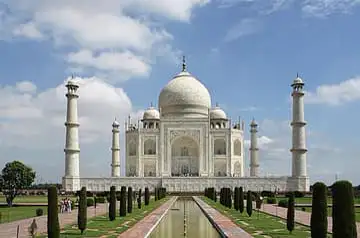
Taj Mahal. (15 m vs 73 m) Taj Mahal →
Nearby on the globe
_-_img_01.jpg)
Sources
Updated: 2026-10-14