
Qutub Minar
쿠트브 미나르
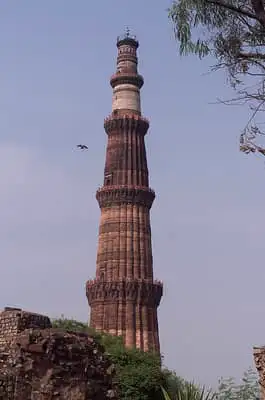
The Qutb Minar is a minaret and victory tower in Mehrauli, South Delhi, India, built during the Delhi Sultanate. It is part of the Qutb complex, a UNESCO World Heritage Site. It was mostly built between 1199 and 1220, has 399 steps, and is about 72.5 metres tall, which makes it the tallest brick minaret in the world according to the card. It is one of the most visited heritage places in the city.
See it on the 3D globe →At a glance
- Country
- India
- Location
- Delhi, India
- Built
- 1220
- Height
- 72.5 m
- Type
- Tower
Quick answers
Where is Qutub Minar?
Qutub Minar is in Delhi, India.
When was Qutub Minar built?
Qutub Minar was built in 1220.
How tall is Qutub Minar?
Qutub Minar is about 72.5 m tall.
A 72.5 m fluted minaret of red sandstone, built by the early Delhi Sultanate.
Qutb-ud-din Aibak began the tower after defeating Prithviraj Chauhan, the last Hindu ruler of Delhi before the Ghurid conquest. It was meant to mark the start of Islamic rule in the region, but he finished only the first level. Later rulers of the Delhi Sultanate continued the work.
A tower in stages
Shamsu'd-Din Iltutmish added more floors after Aibak. In 1368 Firuz Shah Tughlaq rebuilt the top parts and added a cupola. The tower was damaged by an earthquake in 1505 and repaired by Sikandar Lodi, and a bigger earthquake on 1 September 1803 caused serious damage. In 1828 Major Robert Smith renovated it and put a pillared cupola on the fifth storey. That cupola was taken down in 1848 and now stands on the ground to the east, where it is called Smith's Folly.
Carved and fluted
The shaft is fluted, with stalactite-like brackets under the balconies at the top of each stage. Its surface is covered with inscriptions and geometric patterns. The Minaret of Jam in Afghanistan, from about 1190, is a similar all-brick tower of 62 metres. Hindu craftsmen worked on the tower under Muslim architects, and some did not know the Quran, so the inscriptions mix Quranic texts and other Arabic phrases.
Neighbours in the complex
The Quwwat-ul-Islam Mosque, built by Aibak in 1199, is the earliest surviving mosque built by the Delhi Sultans. It used the carved columns of 27 Jain and Hindu temples. In its courtyard stands an iron pillar with a Sanskrit inscription in Brahmi script from the fourth century CE, set up in memory of a mighty king named Chandra as a standard of the god Vishnu.
Fun facts
- Next to it stands an iron pillar about 1,600 years old that has hardly rusted.
- The tower has 399 steps.
- The cupola that Major Smith added in 1828 now stands on the ground as Smith's Folly.
- The iron pillar nearby carries an inscription from the fourth century CE.
- The tower is named for Aibak, or possibly for the Sufi saint Qutbuddin Bakhtiar Kaki.
On the globe
The model shows the fluted red tower with its balconies. Look at how it narrows toward the top.
Quiz time
Which is taller: Qutub Minar or Lotus Temple?
Show the answer
Qutub Minar. (72.5 m vs 34 m) Lotus Temple →
Nearby on the globe






Sources
Updated: 2026-10-14