
Taj Mahal
타지마할
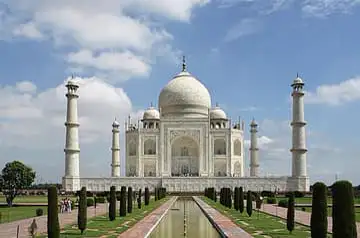
The Taj Mahal is a gleaming white marble mausoleum, a grand building made to hold a tomb, on the bank of the Yamuna River in Agra, India. The Mughal emperor Shah Jahan ordered it in 1631 for his beloved wife Mumtaz Mahal, who had died that year. Later, Shah Jahan himself was buried beside her.
See it on the 3D globe →At a glance
- Country
- India
- Location
- Agra, India
- Built
- 1653
- Height
- 73 m
- Type
- Monument
Quick answers
Where is Taj Mahal?
Taj Mahal is in Agra, India.
When was Taj Mahal built?
Taj Mahal was built in 1653.
How tall is Taj Mahal?
Taj Mahal is about 73 m tall.
A white-marble mausoleum built by Mughal emperor Shah Jahan in memory of his wife; a masterpiece of Mughal architecture.
The tomb stands at the heart of a 17-hectare complex with a mosque, a matching guest building, a grand gateway and formal gardens. The main tomb was finished in 1648, and the whole complex in about 1653. It is seen as one of the finest examples of Mughal architecture, which blended Indian, Persian and Islamic styles. UNESCO made it a World Heritage Site in 1983, and it draws millions of visitors every year.
How it was built
More than 20,000 workers and craftspeople took part, led by a team of architects headed by Ustad Ahmad Lahori, the emperor's court architect. Workers came from India, Persia, the Ottoman Empire and Europe, and around 1,000 elephants are said to have helped carry materials. The tomb is built of white marble, while the other buildings in the complex use red sandstone. The whole complex sits on a raised platform about 300 metres long beside the river.
What's inside and around it
The central dome rises to about 73 metres, with four smaller domes around it. Four slender towers called minarets, each more than 40 metres tall, stand at the corners. The white marble is decorated with carvings and with pietra dura, a technique where small pieces of coloured stone are set into marble to make flowers and vines. Verses from the Quran are written in beautiful calligraphy around the arches. Inside, the decorated tombs you see are cenotaphs, or empty memorial tombs; the real graves lie in a quieter room below.
Protecting it today
After the Mughal empire weakened, the Taj Mahal was neglected for a long time, and a big restoration took place around the start of the 1900s. Today the main danger is air pollution, which can yellow the white marble. In 1998 India's Supreme Court ordered steps to protect it, such as closing some nearby factories and keeping cars away from the area right around the complex.
Fun facts
- Shah Jahan built it in memory of his wife Mumtaz Mahal, who died in 1631.
- The four minarets were built leaning very slightly outward, so that if one ever fell, it would fall away from the tomb.
- The marble seems to change colour during the day as the light changes.
- Mumtaz Mahal died after giving birth to the couple's 14th child.
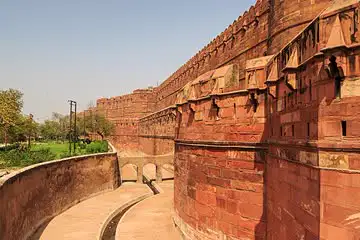
- Shah Jahan spent his last years held in Agra Fort, with a view across the river to the Taj Mahal.
On the globe
The model shows the white marble tomb with its big onion-shaped dome and four corner minarets in Agra, India. Look for the smaller domes around the main one.
Quiz time
Which is taller: Taj Mahal or Lotus Temple?
Show the answer
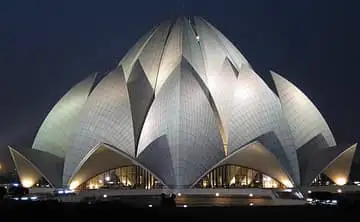
Taj Mahal. (73 m vs 34 m) Lotus Temple →
Nearby on the globe
.jpeg)
Sources
Updated: 2026-10-13