
Humayun's Tomb
후마윤의 묘
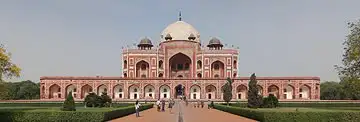
Humayun's Tomb is the tomb of the Mughal Emperor Humayun in Delhi, India. It was the first garden-tomb on the Indian subcontinent and the first building to use red sandstone on such a large scale. The red walls are trimmed with white marble and topped by a double dome.
See it on the 3D globe →At a glance
- Country
- India
- Location
- Delhi, India
- Built
- 1572
- Height
- 47 m
- Type
- Monument
Quick answers
Where is Humayun's Tomb?
Humayun's Tomb is in Delhi, India.
When was Humayun's Tomb built?
Humayun's Tomb was built in 1572.
How tall is Humayun's Tomb?
Humayun's Tomb is about 47 m tall.
Tomb of the Mughal emperor Humayun — red sandstone, white marble and a double dome, the prototype of the Taj Mahal.
UNESCO named it a World Heritage Site in 1993. Many people see it as the model for the Taj Mahal, which was built in Agra about 80 years later. Besides the emperor, the tomb holds the graves of his chief wife and many later Mughal family members.
Who built it
Humayun died in January 1556. His first wife and chief consort, Empress Bega Begum, ordered the tomb, and she chose the Persian architect Mirak Mirza Ghiyas, who came from Herat. He died before it was finished, so his son Sayyid Muhammad completed it. Building began in 1565 and ended in 1572, and the empress paid the whole cost of about 1.5 million rupees.
A garden and a model for later tombs
The tomb stands in a charbagh, a Persian garden divided into four squares by walkways, a style new to India. It follows the tomb of the ruler Timur in Samarkand and set the pattern for later Mughal tombs. The site beside the Yamuna River was chosen to be near the shrine of the Sufi saint Nizamuddin Auliya, whom Delhi's rulers greatly respected.
Ups and downs through the centuries
The garden did not always look the way it does today. As the Mughals declined in the 1700s, it became too costly to keep, and people planted vegetables there. After 1857 the British replanted it in an English garden style, and between 1903 and 1909 the Mughal design was restored. In 1857 the last Mughal emperor, Bahadur Shah Zafar, took refuge here before he was captured.
Fun facts
- It was the first garden-tomb in India and an inspiration for the Taj Mahal.
- It was the first garden-tomb in India.
- It was the first building in India to use red sandstone on such a large scale.
- A merchant who visited in 1611 wrote that the cenotaph was covered with a white sheet and Humayun's sword, turban and shoes lay beside it.
- Bega Begum paid the whole building cost herself.
On the globe
The model shows the red sandstone tomb with white marble trim and a double dome. Look for the garden layout around it.
Quiz time
Which is taller: Humayun's Tomb or Lotus Temple?
Show the answer
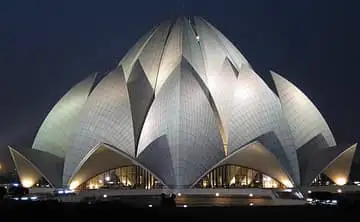
Humayun's Tomb. (47 m vs 34 m) Lotus Temple →
Nearby on the globe

Sources
- Read more on Wikipedia
- Humayun's tomb — Wikipedia
- 델리의 후마윤 묘지 — 위키백과
- Humayun's tomb — Wikipedia (full article)
Updated: 2026-10-14