
Luxor Temple
룩소르 신전
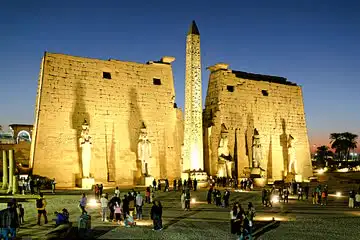
Luxor Temple is a large ancient Egyptian temple on the east bank of the Nile in the city of Luxor, once called Thebes. It was built around 1400 BC, and its Egyptian name meant 'the southern sanctuary'. Famous parts include the huge entrance gate, called a pylon, statues of Ramesses II, and a great colonnade, a long row of columns, from the time of Amenhotep III.
See it on the 3D globe →At a glance
- Country
- Egypt
- Location
- Luxor, Egypt
- Built
- -1400
- Height
- 24 m
- Type
- Religious building
Quick answers
Where is Luxor Temple?
Luxor Temple is in Luxor, Egypt.
When was Luxor Temple built?
Luxor Temple was built in 1400 BC.
How tall is Luxor Temple?
Luxor Temple is about 24 m tall.
A Nile-side temple fronted by a pylon with an obelisk and colossi of Ramesses II, famed for Amenhotep III's great colonnade.
Unlike many other temples, it was not mainly for one god or for a dead pharaoh. It was linked to the renewal of the pharaoh's kingship, and many kings may have been crowned here, in reality or in ceremony. Along with the other sites of ancient Thebes, it was listed by UNESCO as a World Heritage Site in 1979.
Pharaohs and festivals
Amenhotep III built much of the temple, and Tutankhamun and Ramesses II added to it. The temple was tied to the Theban Triad of Amun, his wife Mut and their son Khonsu. Every year, during the Opet Festival, a statue of Amun was carried from Karnak Temple to Luxor to promote the fertility of the god and the pharaoh. A road about 2.7 kilometres long, lined with human-headed sphinxes, joined the two temples, with six resting shrines for the sacred boats.
Stone, tricks and obelisks
The temple was built of sandstone from the Gebel el-Silsila area. Two obelisks, tall carved stone needles, flanked the entrance. They were not the same height, but the layout of the temple makes them look equal. The smaller one now stands in the Place de la Concorde in Paris.
Buried and brought back
From the Middle Ages, people settled in and around the temple. Rubble piled up until it formed an artificial hill about 15 metres high that buried much of the building. Excavation led by Gaston Maspero began after 1884. During Roman times the temple was part of a legionary fortress, and one chapel was turned into a church. A working mosque, the Abu Haggag Mosque, still sits inside the temple.
Fun facts
- One of the two obelisks from its entrance now stands in the Place de la Concorde in Paris.
- One of the two entrance obelisks now stands in Paris.
- A 2.7-kilometre avenue of sphinxes once linked Luxor Temple to Karnak.
- A working mosque still sits inside the temple.
- Medieval rubble buried the temple under a hill about 15 metres high.
On the globe
The model shows the temple with its entrance gate, obelisk, statues of Ramesses II and a colonnade.
Quiz time
Which is taller: Luxor Temple or Temple of Hatshepsut?
Show the answer
Temple of Hatshepsut. (24 m vs 30 m) Temple of Hatshepsut →
Nearby on the globe

Sources
Updated: 2026-10-14