
Karnak Temple
카르나크 신전
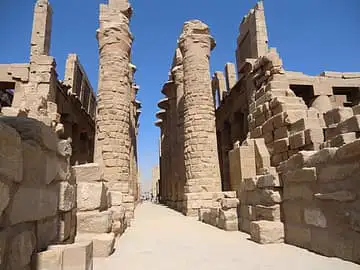
Karnak is a vast mix of temples, pylons, chapels and other buildings near Luxor, Egypt. It was the main place of worship of the Theban Triad led by the god Amun, and it is part of the monumental city of ancient Thebes, which UNESCO added to the World Heritage List in 1979. It is believed to be the second most visited historical site in Egypt, after the Giza pyramids.
See it on the 3D globe →At a glance
- Country
- Egypt
- Location
- Luxor, Egypt
- Built
- c. 2000 BC
- Type
- Religious building
Quick answers
Where is Karnak Temple?
Karnak Temple is in Luxor, Egypt.
A vast temple complex expanded over two millennia, famed for its Great Hypostyle Hall of 134 columns.
Construction began under Senusret I (reigned 1971 to 1926 BCE) in the Middle Kingdom and continued into the Ptolemaic Kingdom, which ended in 30 BCE. Most of the buildings that survive date from the New Kingdom. About thirty pharaohs added to the site, which gave it a size, complexity and variety found nowhere else.
What the name means
The ancient Egyptians called the area Ipet-isut, meaning The Most Select of Places. The modern name Karnak comes from the nearby village of el-Karnak, 2.5 kilometres north of Luxor, whose name means fortified village. The complex also contains the Karnak Open Air Museum.
The Great Hypostyle Hall
The Great Hypostyle Hall in the Precinct of Amun-Re covers 5,000 square metres and holds 134 massive columns in 16 rows. Of these, 122 are about 10 metres tall and 12 are about 21 metres tall and over 3 metres wide. The stone beams on top are thought to weigh 70 tons each. Experts think they were raised along ramps of sand, mud, brick or stone. A shrine of the sun god was built so that light would shine on it at the winter solstice.
Parts of the complex
Karnak has four main parts, but only the largest, the Precinct of Amun-Re, is currently open to the public. The Precinct of Mut, the Precinct of Montu and the dismantled temple of Amenhotep IV (Akhenaten) are closed. Later cultures also reused the buildings, and there is evidence of Coptic churches inside. In 2009 the University of California, Los Angeles launched a website with virtual reality reconstructions of Karnak.
Fun facts
- About thirty pharaohs added to Karnak over roughly 2,000 years.
- The Great Hypostyle Hall has 134 columns, and 12 of them are about 21 metres tall.
- The ancient name meant The Most Select of Places.
- A shrine in the temple was built to catch the winter solstice light.
On the globe
The model shows the temple complex with its tall gateways and the forest of columns.
Nearby on the globe

Sources
Updated: 2026-10-14