
Valley of the Kings
왕가의 계곡
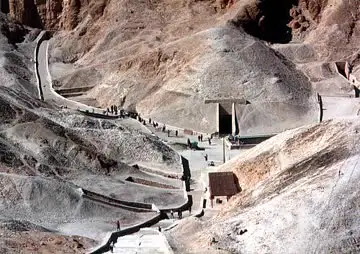
The Valley of the Kings is a dry valley on the west bank of the Nile, across the river from Luxor in Egypt. For nearly 500 years, from the 18th to the 20th dynasty, pharaohs and powerful nobles of the New Kingdom were buried in tombs cut deep into its rock. Today 65 tombs and chambers are known, from a simple pit to KV5, which has more than 120 chambers for the sons of Ramesses II.
See it on the 3D globe →At a glance
- Country
- Egypt
- Location
- West Bank, Luxor, Egypt
- Built
- c. 1539–1075 BC
- Type
- Ancient site
Quick answers
Where is Valley of the Kings?
Valley of the Kings is in West Bank, Luxor, Egypt.
A desert valley holding over 60 rock-cut tombs of New Kingdom pharaohs, including Tutankhamun's.
The tomb walls are painted with scenes from Egyptian myth and show how people of that time imagined the afterlife. Almost all the tombs were opened and robbed in ancient times, yet they still give a good idea of how rich and powerful the pharaohs were. The valley became world-famous in 1922, when the tomb of Tutankhamun was found, and it has been a UNESCO World Heritage Site since 1979.
Why here, and how the tombs were cut
The valley sits over more than 1,000 feet of limestone and other sedimentary rock, laid down between 35 and 56 million years ago. Steady rains later carved the valley out of the plateau. The rock is uneven: some parts are fine-grained, others coarse and crumbly, and builders sometimes changed a tomb's shape to suit the stone they met. Looming above is a pyramid-shaped peak called al-Qurn, which may have echoed the old pyramids, and its remote position made the valley easy for special tomb police to guard.
A typical tomb has a long sloping corridor leading down through halls to the burial chamber, perhaps copying the sun god's journey into the underworld. Early tombs bend at sharp angles, and later ones run straight.
Who built them and who found them
The tombs were cut and painted by workers who lived in the village of Deir el-Medina. Their daily lives are well known from records, including what may be the first workers' strike in history, written on the Turin Strike Papyrus. Ancient visitors came too: more than 2,100 Greek and Latin scribbles have been found on the walls, mostly in tomb KV9.
In the 1800s explorers such as Giovanni Belzoni found many tombs. In 1912 the American Theodore Davis even wrote that the valley was probably exhausted. Ten years later, in November 1922, Howard Carter and Lord Carnarvon proved him wrong by finding Tutankhamun's tomb.
Not only kings
Despite its name, the valley also holds the tombs of favoured nobles and of wives and children of pharaohs, so only about twenty tombs really contained kings. Some kings are buried elsewhere or have never been found. Archaeologists are still exploring, and only eleven tombs have been completely recorded. Flash floods from rare, violent storms still pour debris into open tombs, which makes protecting them hard.
Fun facts
- Howard Carter found Tutankhamun's tomb here in 1922.
- Its tomb numbers start with 'KV', short for Kings' Valley.
- Only about twenty of the valley's tombs actually held kings.
- The valley's tombs were hidden on purpose, and the tomb police (the Medjay) guarded the area.
- The oldest dated graffiti left by ancient tourists in the valley is from 278 BC.
On the globe
The model shows the rocky desert valley with tomb entrances cut into the cliffs. Look for the doorways in the rock.
Nearby on the globe

.jpg)
Sources
Updated: 2026-10-14