
Abu Simbel Temples
아부심벨 신전
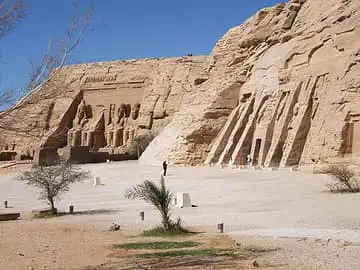
Abu Simbel is a pair of enormous temples carved straight into a sandstone cliff in southern Egypt, near the border with Sudan, on the shore of Lake Nasser. They were made for the pharaoh Ramesses II more than 3,200 years ago. The Great Temple honours important Egyptian gods and Ramesses himself, and the Small Temple honours the goddess Hathor and his queen, Nefertari.
See it on the 3D globe →At a glance
- Country
- Egypt
- Location
- Aswan Governorate, Egypt
- Built
- -1244
- Height
- 20 m
- Type
- Religious building
Quick answers
Where is Abu Simbel Temples?
Abu Simbel Temples is in Aswan Governorate, Egypt.
When was Abu Simbel Temples built?
Abu Simbel Temples was built in 1244 BC.
Rock-cut temples of Ramesses II fronted by four colossal statues, relocated whole to escape a dam's lake.
Four giant seated statues of Ramesses II, each about 20 metres tall, guard the entrance of the Great Temple. In the 1960s, a new dam on the Nile was about to flood the temples, so an international team cut them into more than a thousand blocks and rebuilt them on higher ground. Today they are part of the UNESCO World Heritage Site called the Nubian Monuments.
History
Building began around 1264 BC and took about 20 years. The temples stood in Nubia, a land to the south that Egypt controlled and that was rich in gold, so they also showed off Egypt's power. Carvings inside the Great Temple celebrate Ramesses at the Battle of Kadesh. Over the centuries, drifting sand buried much of the Great Temple. In 1813 the Swiss traveller Johann Ludwig Burckhardt saw the top of it, and a few years later the Italian explorer Giovanni Belzoni dug his way inside. One story says the site was named after a local boy who guided an explorer there, but no one knows if that is true.
The great move
When Egypt built the Aswan High Dam, the lake behind it, Lake Nasser, would have drowned the temples. UNESCO led a worldwide campaign to save the monuments of Nubia, and a Swedish engineering firm suggested cutting the temples into pieces. Workers sawed the soft sandstone mostly by hand, carefully numbering every block: 1,036 in all. From 1964 to 1968 they lifted the temples and rebuilt them 65 metres higher and about 200 metres farther from the river, inside a hill made over a huge concrete dome. They also kept the temples facing exactly the same direction as before.
The sun's visit
The Great Temple was lined up so that, around 22 February and 22 October, the rising sun shines straight through the doorway and deep into the innermost room. Its rays light up statues of gods and the king on the back wall. Only one statue stays in the dark: Ptah, a god connected with the world of the dead. Crowds still gather on these days to watch the sunlight reach the back of the temple, more than 3,000 years after it was carved.
Fun facts
- Between 1964 and 1968 the temples were cut into blocks and moved to higher ground.
- One of the four giant statues lost its head and upper body in an earthquake long ago, and the broken pieces still lie at its feet.
- Small statues of Ramesses' family stand beside the giants' legs, and none is taller than the pharaoh's knees.
- The temples were cut into 1,036 blocks so they could be moved.
- The temples were moved 65 metres higher up, and the builders kept them facing the same way so the sun would still shine inside.
- Long ago, Greek soldiers scratched their names into the legs of the giant statues.
On the globe
The model shows the Great Temple's cliff front with four giant seated statues of Ramesses II. Look for the small doorway between them that leads deep into the rock.
Quiz time
Which is older: Abu Simbel Temples or Temple of Hatshepsut?
Show the answer
Temple of Hatshepsut. (1244 BC vs 1470 BC) Temple of Hatshepsut →
Nearby on the globe

Sources
Updated: 2026-10-13