
Machu Picchu
마추픽추
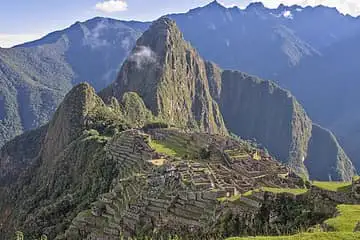
A 15th-century Inca citadel on an Andean ridge, that escaped destruction by the Spanish conquerors and became widely known to the outside world only in 1911.
See it on the 3D globe →At a glance
- Country
- Peru
- Location
- Cusco Region, Peru
- Built
- 1450
- Type
- Ancient site
Quick answers
Where is Machu Picchu?
Machu Picchu is in Cusco Region, Peru.
When was Machu Picchu built?
Machu Picchu was built in 1450.
Machu Picchu is a stone city built by the Inca on a narrow mountain ridge in southern Peru. It sits about 2,430 metres above sea level, high above the Urubamba River and roughly 80 km northwest of Cusco, the old Inca capital. Building probably began around 1450, and many archaeologists think it was a royal estate for the emperor Pachacuti, a kind of mountain retreat.
The Inca left the site in the 1500s, around the time of the Spanish conquest, and it was never destroyed. Local farmers knew about it, but the wider world did not until the explorer Hiram Bingham made it famous in 1911. Today it is a UNESCO World Heritage Site (since 1983) and was voted one of the New Seven Wonders of the World in 2007.
How it was built
The Inca were brilliant stoneworkers. Many walls at Machu Picchu are made of granite blocks cut so carefully that they fit together without any mortar, the cement-like paste usually used to glue stones. Some blocks are neat rectangles, while others have many sides and were shaped for one exact spot. Because the stones lock together and can shift slightly, the walls have survived earthquakes well. About 200 buildings stand on terraces around a central square, and farming terraces covering about 5 hectares step down the slopes.
What's inside the city
Visitors can see temples, homes, storehouses and fountains. The Temple of the Sun is a curved tower built on top of a rock. The Temple of the Three Windows looks out over the valley, and the Intihuatana is a carved ritual stone on a high point of the site. Around 750 people may have lived here, mostly workers who served the royal family. Farmers grew corn and potatoes on the terraces, but that was not enough food for everyone, so more was carried in from nearby valleys.
Visiting today
Machu Picchu is Peru's most famous sight, and well over a million people visit each year. To protect the old stones, Peru limits how many people can enter each day, and visitors follow set routes and time slots. Many people arrive by train and bus from the valley below, while hikers can reach it along old Inca paths through the mountains.
Fun facts
- Explorer Hiram Bingham made it famous around the world in 1911.
- Some Inca walls fit so tightly that no mortar was needed to hold the stones together.
- Peru set a daily visitor limit to protect the site; in 2024 it was raised to 4,500 people a day.
- Archaeologists found bones of llamas and alpacas at the site, along with guinea pigs and dogs.
- The city was probably a royal country estate for the Inca emperor Pachacuti.
- In 2007 it was voted one of the New Seven Wonders of the World.
On the globe
The model shows the 15th-century Inca stone city on its Andean ridge. Look for the stone buildings and terraces perched high on the mountainside.
Quiz time
Which is older: Machu Picchu or Nazca Lines?
Show the answer
Nazca Lines. (1450 vs 500) Nazca Lines →
Nearby on the globe
.jpg)
Sources
Updated: 2026-10-13