
Sacsayhuamán
삭사이우아만
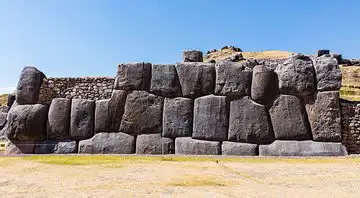
Sacsayhuaman is an Inca fortress on a steep hill above Cusco, Peru, the old capital of the Inca Empire. It sits at an altitude of 3,701 metres, and its name in the Quechua language is often translated as fortress of the royal falcon. From the hill there is a wide view over the valley to the southeast.
See it on the 3D globe →At a glance
- Country
- Peru
- Location
- Cusco, Peru
- Built
- 15th century
- Type
- Fort
Quick answers
Where is Sacsayhuamán?
Sacsayhuamán is in Cusco, Peru.
An Inca citadel above Cusco whose three zigzag terraces are built of gap-free polygonal boulders, some over 100 tonnes.
Its walls are famous. Huge boulders, some weighing over 100 tonnes, were cut so precisely that they fit together without mortar. Their precision is described as unmatched in the Americas. Together with Cusco, the site became a UNESCO World Heritage Site in 1983.
Who built it?
Spanish chroniclers recorded Inca stories saying the fortress was built under the Sapa Inca Pachacuti and his successors, Topa Inca Yupanqui and Huayna Capac. Pottery studies show people used the hilltop as early as about 900 CE. The Inca saw Cusco as shaped like a lion, with Sacsayhuaman as its head. A chronicler wrote that the Inca ordered the provinces to send 20,000 men, including 4,000 to quarry stone and 6,000 to haul it with leather ropes.
The great walls
The best-known part of the site is a great plaza and three massive terraced walls built of dry stone, meaning stones laid without mortar. The stones are among the largest used in any pre-Hispanic building in the Americas, and many fit so closely that a single piece of paper will not slide between them. The Spanish chronicler Pedro Cieza de Leon wrote in 1553 that it was hard to understand how people with so few tools could have shaped and moved them.
After the Spanish arrived
After the siege of Cusco, the Spaniards began to use Sacsayhuaman as a source of stone for their new colonial city, and within a few years they took apart much of the complex block by block. That is why the walls we see are only part of the original fortress. Today the site is a major tourist destination, and every year on 24 June Peruvians celebrate Inti Raymi, the Inca winter solstice festival and new year, near Sacsayhuaman.
Fun facts
- The stones fit together without any mortar.
- Some stones weigh more than 100 tonnes.
- Sacsayhuaman is 3,701 metres above sea level.
- The Inca saw Cusco as a lion, and this fort was its head.
On the globe
The model shows the three zigzag terraces of giant stone blocks above Cusco.
Nearby on the globe

Sources
Updated: 2026-10-14