
Nazca Lines
나스카 라인
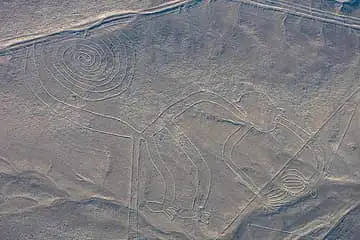
The Nazca Lines are giant drawings scratched into the ground of the Nazca Desert in southern Peru, about 400 kilometres south of the capital, Lima. Pictures made on the ground like this are called geoglyphs. Most of the Nazca Lines are long straight lines and geometric shapes, but more than 70 are pictures of animals and plants, including a hummingbird, a monkey, a spider, a condor and a fish.
See it on the 3D globe →At a glance
- Country
- Peru
- Location
- Nazca, Peru
- Built
- 500
- Type
- Ancient site
Quick answers
Where is Nazca Lines?
Nazca Lines is in Nazca, Peru.
When was Nazca Lines built?
Nazca Lines was built in 500.
Huge figures of animals and shapes etched into the desert floor, best seen from the air.
They were made between about 500 BC and AD 500, first by people of the Paracas culture and then by the Nazca people. Added together, the lines stretch more than 1,300 kilometres. Some figures are so big that they are best seen from the air, although many can also be spotted from nearby hills. The lines became a UNESCO World Heritage Site in 1994, and new figures are still being discovered today.
How they were made
The desert floor is covered with reddish-brown stones coated in rusty iron oxide. To draw a line, the Nazca people removed these stones, uncovering the paler yellow-grey ground below. Most lines are only 10 to 15 centimetres deep. Archaeologists have found wooden stakes at the ends of some lines, which suggests the makers measured them out with simple surveying tools. In the 2000s, an investigator used only tools the Nazca could have had and showed that a small team could copy even the largest figures in a few days.
The mystery: why were they made?
Nobody wrote down why the lines were made, so scientists have several ideas. In the 1940s the American historian Paul Kosok noticed a line pointing to where the sun set on the winter solstice and called the area the largest astronomy book in the world. The German mathematician Maria Reiche spent about 40 years studying and protecting the lines. Many researchers now think the lines were part of religious ceremonies to ask for water, which was precious in this dry land. People may have walked along them, and the animals may stand for rain, fertility or water.
The legend vs the facts
In 1968 a popular book claimed the lines were landing strips for visitors from outer space. Scientists rejected this idea: there is no evidence for it, and experiments show that people with ropes, stakes and careful planning could make every figure. What really kept the lines safe for so long is the weather. The plateau is very dry, with almost no rain or wind. Even so, the lines are fragile: in 2014 activists damaged ground next to one figure while setting up a banner, and off-road rally cars have scarred geoglyphs outside the protected area.
Fun facts
- The figures include a hummingbird, a monkey and a spider.
- The hummingbird figure is 93 metres long, the monkey is 93 by 58 metres, and the condor stretches 134 metres.
- In 2020 archaeologists spotted a figure of a cat on a steep hillside, where erosion had kept it hidden.
- In 2024 a team from Yamagata University in Japan used artificial intelligence to help find 303 new figures, including parrots, cats, monkeys and killer whales.
- Most of the shapes are drawn with a single continuous line.
On the globe
The model shows huge animal figures and shapes etched into the desert floor of southern Peru. Zoom in close, as if you were flying over in a small plane, to see the whole pictures.
Quiz time
Which is older: Nazca Lines or Machu Picchu?
Show the answer
Nazca Lines. (500 vs 1450) Machu Picchu →
Nearby on the globe

Sources
Updated: 2026-10-13