
Amundsen–Scott South Pole Station
아문센-스콧 남극점 기지
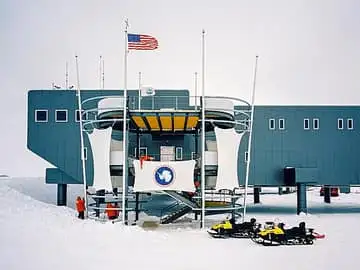
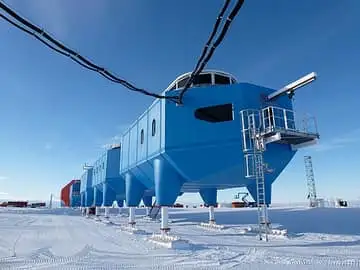
The US station at the geographic South Pole, raised on stilts so drifting snow passes beneath; beside it stands the ceremonial pole with its mirror ball.
See it on the 3D globe →At a glance
- Country
- Antarctica
- Location
- Geographic South Pole
- Built
- 1956
Quick answers
Where is Amundsen–Scott South Pole Station?
Amundsen–Scott South Pole Station is in Geographic South Pole, Antarctica.
When was Amundsen–Scott South Pole Station built?
Amundsen–Scott South Pole Station was built in 1956.
The Amundsen–Scott South Pole Station is a United States science base at the geographic South Pole, the very bottom of the Earth at 90° south. It sits on top of the Antarctic ice sheet about 2,835 metres above sea level, and the ice underneath is nearly 3 kilometres thick. It is the southernmost place in the world where people live all year round.
The station was first built in November 1956 for the International Geophysical Year, a worldwide science project to study the Earth, and people have lived there ever since. It is named after two explorers who raced to reach the pole: Roald Amundsen of Norway, who arrived first in December 1911, and Robert Falcon Scott of Britain, who arrived in January 1912. Today it is run by the US National Science Foundation and is one of the best places on Earth to study the sky.
Life at the bottom of the world
At the South Pole the Sun stays up for about six months and then stays down for about six months, so the year has one very long day and one very long night. The average yearly temperature is around −49 °C, and in winter it can fall below −80 °C. It hardly ever snows, only about 2.5 cm a year, so the pole is actually a desert made of ice. Up to about 150 people work there in summer, but only a few dozen stay through the dark winter, when planes usually cannot land. A small greenhouse grows fresh vegetables in water instead of soil.
A building on stilts
The station has been rebuilt several times. From 1975 to 2010 the main base sat under a big geodesic dome, a rounded frame made of many triangles, 50 metres wide. The current station was dedicated in 2008. It stands on tall legs, called stilts, and faces into the wind. Its lower wall slopes so that wind speeds up as it rushes underneath, sweeping away snow instead of letting it pile up. If snow does build up, the whole building can be jacked up a full floor on its columns.
Science at the pole
The air at the South Pole is extremely cold, dry and clean, and in winter there is no sunlight to get in the way, which makes it perfect for watching the sky. Scientists use the South Pole Telescope to study the faint light left over from the Big Bang. Buried deep in the ice is IceCube, a detector a whole cubic kilometre in size that catches signs of tiny space particles called neutrinos. Researchers also study weather, earthquakes, the air and the ice itself.
Fun facts
- It is named after Roald Amundsen and Robert Falcon Scott, who reached the pole in 1911 and 1912.
- The ice under the station slides about 10 metres every year, so the station slowly drifts away from the exact pole.
- From the station, the Sun stays in the sky for about six months in a row.
- Even though it is covered in ice, the South Pole gets so little snow that it counts as a desert.
- The building can be lifted a whole floor higher on jacks if snow starts to bury it.
- The station serves more than 24,000 meals a year.
On the globe
The model shows the station raised on stilts so that drifting snow can blow beneath it, with the ceremonial South Pole marker topped by a mirror ball standing beside it. Zoom all the way to the bottom of the globe to find it.
Nearby on the globe


Sources
- Read more on Wikipedia
- Amundsen–Scott South Pole Station — Wikipedia
- 아문센-스콧 기지 — 위키백과
- NSF Amundsen-Scott South Pole Station — U.S. National Science Foundation
- South Pole Station webcam and information — U.S. Antarctic Program
Updated: 2026-10-13