
Moai
모아이
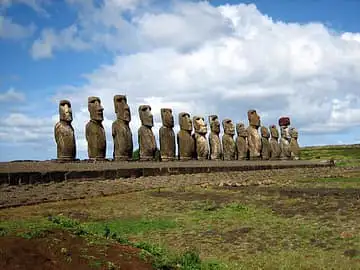
Moai are giant stone figures carved by the Rapa Nui people of Easter Island, a small, remote island in the Pacific Ocean that belongs to Chile. Most were made between about 1250 and 1500. More than 900 moai are known, and each one is a single block of stone shaped into a human figure with a large head, a long nose and a heavy brow.
See it on the 3D globe →At a glance
- Country
- Chile
- Location
- Easter Island, Chile
- Built
- 1500
- Height
- 4 m
- Type
- Statue
Quick answers
Where is Moai?
Moai is in Easter Island, Chile.
When was Moai built?
Moai was built in 1500.
How tall is Moai?
Moai is about 4 m tall.
Monolithic stone figures carved by the Rapa Nui people to honour their ancestors.
The statues are thought to represent important ancestors. Many were placed on stone platforms called ahu, facing inland toward the villages, as if watching over the people. How the islanders moved such heavy statues across the island is a question scientists are still studying. Today the statues are protected inside Rapa Nui National Park, which became a UNESCO World Heritage Site in 1995.
How they were made
Most moai were carved from tuff, a rock made of squashed volcanic ash, at a quarry on the side of the volcano Rano Raraku. Nearly half of all known moai are still at the quarry, some buried up to their shoulders, which is why so many photos show only giant heads. The average moai is about 4 metres tall and weighs around 12.5 tonnes. The tallest one ever set up is almost 10 metres high, and an unfinished statue still lying in the quarry would have been about 21 metres tall.
The mystery of how they moved
How did people move such heavy statues across the island without wheels or large animals? Older ideas suggested sledges or log rollers. Rapa Nui stories say the statues walked. In 2025 researchers Carl Lipo and Terry Hunt published a study of nearly 1,000 moai that supports this idea. They tied ropes to a 4.35-tonne copy of a moai, and a team of only 18 people rocked it from side to side so it "walked" upright about 100 metres in 40 minutes.
Eyes, hats and fallen giants
Some moai once had eyes made of white coral with dark pupils of obsidian or red stone, discovered in 1979. Some also wore pukao, big cylinders of red volcanic stone set on their heads like topknots. When Europeans first arrived in 1722, many statues were standing, but by 1868 every one had been knocked over. Since then, groups of moai have been raised again on their platforms.
Fun facts
- There are more than 900 moai on the island.
- Nearly half of all moai never left the quarry where they were carved.
- Many moai that look like just heads actually have bodies buried underground.
- A team of 18 people made a 4.35-tonne copy of a moai "walk" 100 metres in 40 minutes.
- An unfinished moai in the quarry would have been about 21 metres tall if it had been completed.
- Some moai once had eyes made of white coral.
On the globe
The model shows the monolithic stone figures carved by the Rapa Nui people to honour their ancestors. Look for their oversized heads and long noses.
Quiz time
Which is taller: Moai or Christ the Redeemer?
Show the answer
Christ the Redeemer. (4 m vs 30 m) Christ the Redeemer →
Nearby on the globe



Sources
- Read more on Wikipedia
- Moai — Wikipedia
- Easter Island's statues actually 'walked' — and physics backs it up — Binghamton University News
Updated: 2026-10-13