
Galápagos Islands
갈라파고스 제도
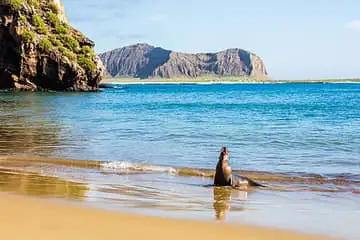
The Galápagos Islands are a group of volcanic islands in the Pacific Ocean, about 900 kilometres west of mainland South America. They belong to Ecuador and sit right around the equator. Counting islets and rocks, there are more than a hundred pieces of land, with about 8,000 square kilometres of land in total.
See it on the 3D globe →At a glance
- Country
- Ecuador
- Location
- Pacific Ocean, Ecuador
Quick answers
Where is Galápagos Islands?
Galápagos Islands is in Pacific Ocean, Ecuador.
Volcanic islands with unique wildlife that helped inspire Darwin's theory of evolution.
Because the islands are so far from any continent, the animals and plants that reached them developed in their own way. Many live nowhere else on Earth, such as giant tortoises, marine iguanas and flightless cormorants. In 1835 the young naturalist Charles Darwin spent about five weeks here, and what he saw helped shape his ideas about how living things change over time, which he later called evolution. The islands became a national park in 1959 and one of the very first UNESCO World Heritage Sites in 1978.
How the islands formed
The Galápagos sit above a hotspot, a place where hot rock from deep inside the Earth melts its way up and builds volcanoes on the sea floor. The ocean plate slowly carries each new volcano away to the east, so a chain of islands of different ages forms. The oldest islands are millions of years old, while Fernandina in the west is only about 50,000 years old, the youngest of all.
Animals found nowhere else
The islands are named after their giant tortoises: galápago is an old Spanish word for tortoise. These are the largest tortoises alive, and some weigh over 400 kilograms. Tortoises on dry islands grew shells shaped like a saddle so they can stretch their necks up to reach plants, while those on wet islands have rounded domes. Marine iguanas are the only lizards today that feed in the sea, diving to graze on seaweed.
Darwin and protecting the islands
The islands were first reached by Europeans in 1535, when a ship carrying the Bishop of Panama drifted off course. Darwin arrived on HMS Beagle on 15 September 1835. He noticed, for example, that mockingbirds were different from one island to the next. In 1959 Ecuador made almost all of the islands a national park, and a research station opened soon after. Today a large marine reserve also protects the sea around them.
Fun facts
- Charles Darwin visited in 1835 aboard HMS Beagle.
- Marine iguanas get rid of extra salt from seawater with a sneeze-like squirt from their noses.
- During hungry El Niño years, some marine iguanas actually got shorter, then grew back when food returned.
- Galápagos tortoises can live for more than 100 years in the wild.
- Early sailors called the Galápagos the "Enchanted Isles" because tricky winds and currents made them hard to find.
On the globe
The model shows volcanic islands in the Pacific off Ecuador, home to unique wildlife. Zoom in near the equator, west of South America, to find them.
Nearby on the globe

,_Punta_Pitt,_isla_de_San_Crist%C3%B3bal,_islas_Gal%C3%A1pagos,_Ecuador,_2015-07-24,_DD_11.JPG)
Sources
- Read more on Wikipedia
- Galápagos Islands — Wikipedia
- History of the Galápagos — Galápagos Conservancy
- Galápagos tortoise — Wikipedia
- Marine iguana — Wikipedia
Updated: 2026-10-13