
Salar de Uyuni
우유니 소금사막
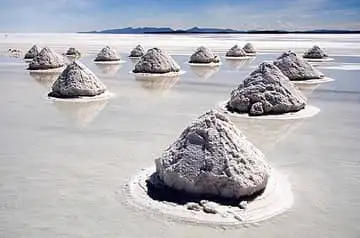
Salar de Uyuni is the largest salt flat in the world, covering about 10,582 square kilometres in southwestern Bolivia, high in the Andes at 3,656 metres above sea level. It sits in the Potosí Department. 'Salar' means salt flat in Spanish, and 'Uyuni' comes from an Aymara word for a pen or enclosure.
See it on the 3D globe →At a glance
- Country
- Bolivia
- Location
- Potosí, Bolivia
Quick answers
Where is Salar de Uyuni?
Salar de Uyuni is in Potosí, Bolivia.
The world's largest salt flat, which turns into a vast sky-reflecting mirror in the rainy season.
In the rainy season, a thin layer of still water turns the white plain into a giant mirror for the sky, and visitors can feel as though they are walking on clouds. The mirror can stretch about 129 kilometres across. The region has a dry climate, with only about 1 to 3 millimetres of rain a month for most of the year.
How did it form?
The Salar came from the slow drying of a chain of huge prehistoric lakes. Lake Minchin, from some 30,000 to 42,000 years ago, was followed by Lake Tauca, up to 140 metres deep, and then Lake Coipasa. When Coipasa dried it left behind two small lakes, Poopó and Uru Uru, and two salt deserts: Salar de Coipasa and the larger Salar de Uyuni. Today the salt layer is about 8 metres thick, and a few islands in its middle are the tops of ancient volcanoes.
Why is it special?
The surface is extremely flat. Its height varies by less than one metre across the whole area. With the big area and clear skies, satellites use it to check their altitude measurements. Under the salt crust is a pool of brine that is exceptionally rich in lithium, a metal used in batteries.
Several kinds of flamingos breed here. The Salar is also a major road across the Bolivian high plateau, except when it is flooded. Films such as Star Wars: The Last Jedi used it as a filming location.
The legend of Tunupa
According to an Aymara legend, the mountains around the Salar, Tunupa, Kusku and Kusina, were giants. Tunupa married Kusku, but Kusku ran away with Kusina. Tunupa cried while nursing her son, and her tears mixed with her milk to form the Salar. Many local people see Tunupa as an important deity, and some say the place should really be called Salar de Tunupa.
Fun facts
- It is so flat that it is used to calibrate satellite altimeters.
- It is the largest salt flat on Earth, at about 10,582 square kilometres.
- Its surface varies in height by less than one metre across the whole area.
- Satellites use it to check their altitude measurements.
- Films such as Star Wars: The Last Jedi used it as a filming location.
On the globe
The model shows the bright white salt plain, with the sky reflected on its wet surface.
Nearby on the globe

Sources
Updated: 2026-10-14