
Tiwanaku (Gate of the Sun)
티와나쿠 (태양의 문)
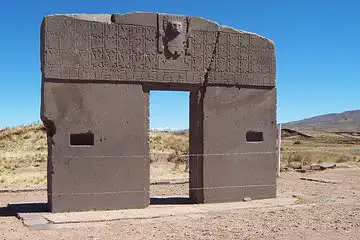
The Gate of the Sun is a gateway carved from a single block of stone at the ancient site of Tiwanaku, near Lake Titicaca in Bolivia. It was made by the Tiwanaku culture, an Andean civilization that thrived around the lake from about AD 500 to 950. The site lies at about 3,825 metres above sea level, around 70 kilometres from La Paz.
See it on the 3D globe →At a glance
- Country
- Bolivia
- Location
- Tiwanaku, Bolivia
- Built
- c. 500–1000
- Type
- Ancient site
Quick answers
Where is Tiwanaku (Gate of the Sun)?
Tiwanaku (Gate of the Sun) is in Tiwanaku, Bolivia.
An ancient city at 3,850 m near Lake Titicaca; its Gate of the Sun, carved from a single andesite block, shows the Staff God.
The gate is about 3 metres tall and 4 metres wide, and its weight is estimated at 10 tons. In the centre is a figure often called the Staff God, with a head surrounded by 24 rays. The carvings are believed to have astronomical or calendar meaning, though nobody can be sure, because the Tiwanaku left no written records.
Found lying down
When European explorers found the gate in the mid-19th century, it was lying flat and had a big crack running through it. It now stands where it was found, but scholars believe this was not its original place, and where it first stood is still uncertain. An engraving of it was used in a book published in 1851.
What do the carvings mean?
The front shows a central figure in the Staff God pose, with 48 smaller 'attendants' running toward it: 32 with human heads and 16 with bird heads. Some thinkers suggest the central figure could be the Inca god Viracocha or an Aymara weather god, while others think it may show ritual practitioners. Many scholars think the patterns have to do with the movement of the sun, moon and seasons. Similar images appear in the Wari culture, and the Inca may have drawn ideas from Tiwanaku.
The city around the gate
Tiwanaku was one of the largest sites in South America, with remains covering about 4 square kilometres and an estimated 10,000 to 20,000 people around AD 800. Its buildings include the Akapana, a stepped platform mound about 16.5 metres tall. Its name may once have been taypiqala, Aymara for 'stone in the center'. The society seems to have collapsed around AD 1000, and a long drought may have played a role.
Fun facts
- The gate was carved from one block of stone weighing about 10 tons.
- It was found lying on the ground with a crack through it.
- Tiwanaku sits at about 3,825 metres, higher than most mountain peaks in Europe.
- The central figure's head is surrounded by 24 rays.
On the globe
The model shows the stone gateway standing on the high plain. Look at the carved figure above the doorway.
Nearby on the globe



Sources
Updated: 2026-10-14