
Richat Structure
리차트 구조 (사하라의 눈)
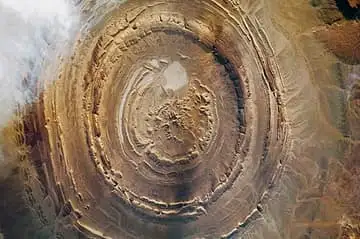
The Richat Structure is a huge round pattern of rock rings in the Sahara Desert in Mauritania, in West Africa. It is about 40 kilometers (25 miles) across. From space it looks like a giant bullseye, so people nicknamed it the Eye of the Sahara or the Eye of Africa.
See it on the 3D globe →At a glance
- Country
- Mauritania
- Location
- near Ouadane, Mauritania
- Built
- natural (eroded dome, ~100 million years)
Quick answers
Where is Richat Structure?
Richat Structure is in near Ouadane, Mauritania.
A 40 km-wide eroded dome of concentric rock rings in the Sahara, so striking from space that it is nicknamed the Eye of the Sahara.
It is not a crater from a space rock, although scientists once thought it might be. It is a dome of layered rock that has been worn down by wind and water, so its different layers show up as rings. It is so large that you cannot see its shape from the ground.
How did it form?
Long ago, hot molten rock pushed up from underground and bent the layers of sedimentary rock above it into a dome. Over a very long time, erosion wore the top away. Harder layers, such as quartzite, stuck out as ridges, while softer rocks were worn into valleys, leaving circles around the center. The oldest rocks are at the middle and younger ones around the edges.
Why do scientists care?
Studies in the 1960s found no signs of the shocked rock that a meteorite impact would leave, so scientists concluded it was formed by Earth's own processes. Inside the structure are volcanic and other igneous rocks. The area also has many stone tools from the Acheulean period of the Old Stone Age. The structure was chosen as one of 100 top geological heritage sites by the International Union of Geological Sciences.
Fun facts
- Seen from space it looks like a giant bullseye, nicknamed the 'Eye of the Sahara'.
- The Richat Structure is about 40 kilometers wide.
- It looks like a bullseye from space.
- Scientists first suspected a meteorite crater, but later studies showed it is an eroded dome.
- In the local Arabic language, one name for it means "feathers".
On the globe
The model shows the circular rings of rock in the desert, like an eye.
Nearby on the globe


Sources
Updated: 2026-10-14