
Sydney Opera House
시드니 오페라하우스
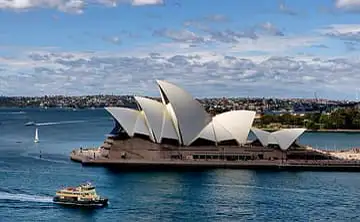
The Sydney Opera House is a performing arts centre on Bennelong Point, a small piece of land poking out into Sydney Harbour in Australia. Its roofs are made of huge white curved shells that look like sails filling with wind. The building was designed by the Danish architect Jørn Utzon and opened by Queen Elizabeth II on 20 October 1973.
See it on the 3D globe →At a glance
- Country
- Australia
- Location
- Sydney, Australia
- Built
- 1973
- Height
- 65 m
- Type
- Theatre
Quick answers
Where is Sydney Opera House?
Sydney Opera House is in Sydney, Australia.
When was Sydney Opera House built?
Sydney Opera House was built in 1973.
How tall is Sydney Opera House?
Sydney Opera House is about 65 m tall.
A performing-arts centre famed for its sail-like shell roofs, one of the great buildings of the 20th century.
Inside are several theatres and concert halls that together host more than 1,800 performances a year, from opera and orchestra concerts to plays. It is one of Australia's most visited places and is seen as a masterpiece of 20th-century architecture. UNESCO named it a World Heritage Site in 2007, describing it as a daring and visionary experiment that changed modern architecture.
History
Long before the building, Bennelong Point, known to Aboriginal people as Tubowgule, was a place for ceremony and gathering. In 1957 Jørn Utzon won an international design competition, and construction began on 2 March 1959. The project grew far more difficult and expensive than planned. After arguments with the government over cost and design, Utzon resigned in 1966 and left Australia. A team led by Australian architect Peter Hall finished the building, especially the interiors. The final cost was about A$102 million.
How the shells were built
For years nobody could work out how to build Utzon's curved roofs. The breakthrough came when Utzon realised that every shell could be cut from the surface of the same imaginary sphere, about 75 metres in radius. That meant the pieces could be made in a factory from repeated shapes, using precast concrete ribs. The engineering firm of Ove Arup helped turn the idea into reality. The shells are covered in more than a million tiles in two colours, glossy white and matte cream, laid in a gentle chevron, or V-shaped, pattern.
Fun facts
- Danish architect Jørn Utzon won the design competition in 1957.
- The roof shells are covered with exactly 1,056,006 tiles, made by a Swedish company.
- From far away the roof looks pure white, but up close you can see a pattern of white and cream tiles.
- Jørn Utzon never returned to Australia to see his finished building.
- Over ten million people visit the site every year, and around 350,000 of them take a guided tour.
On the globe
The model shows the Opera House's sail-like shell roofs on their point of land beside Sydney Harbour. Look for how the shells overlap and rise toward the water.
Quiz time
Which is taller: Sydney Opera House or Aurora Place?
Show the answer
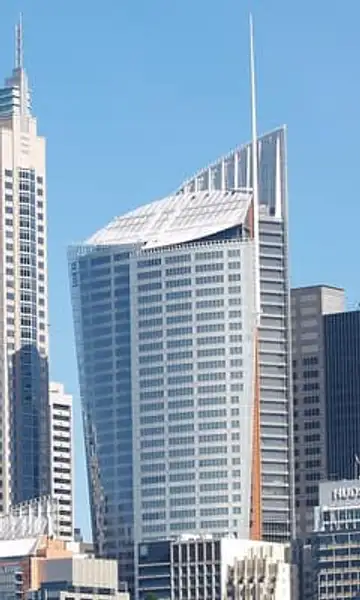
Aurora Place. (65 m vs 218 m) Aurora Place →
Nearby on the globe
.jpg)
Sources
- Read more on Wikipedia
- Sydney Opera House — Wikipedia
- Our story — Sydney Opera House (official site)
- Sydney Opera House — UNESCO World Heritage Centre (archived copy)
Updated: 2026-10-13