
Giant Pacific octopus
대문어
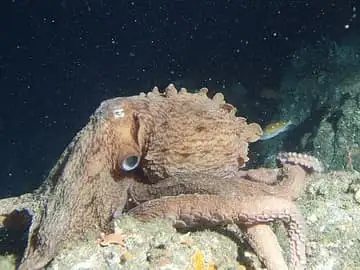
The world's largest octopus, with an arm span of several metres and remarkable intelligence. It has three hearts and blue blood, and can learn to open jars, yet it lives only about three to five years.
See it on the 3D globe →At a glance
- Class
- Molluscs
- Lives in
- North Pacific Ocean
- Diet
- Meat eater (carnivore)
- Weight
- about 15 kg
- Lifespan
- up to about 5 years
- Habitat
- coasts
Quick answers
Where does the Giant Pacific octopus live?
It lives in coasts of the Pacific Ocean. On the globe you can find it near North Pacific Ocean.
How big is the Giant Pacific octopus?
It grows to about 15 kg.
What does the Giant Pacific octopus eat?
Its diet: meat eater (carnivore).
How long does the Giant Pacific octopus live?
It can live up to about 5 years.
The giant Pacific octopus is the largest octopus species in the world. Adults usually weigh around 15 kilograms, and their arms can stretch 2 to 4 metres or more from tip to tip. It lives in cold coastal waters all around the North Pacific Ocean, from Korea and Japan across to Alaska, Canada, the United States and Mexico, from shallow tide pools down to depths of 1,500 metres or more.
Like all octopuses, it is a mollusc, a soft-bodied animal related to clams and snails, but with no outer shell. Octopuses are thought to be the most intelligent invertebrates (animals without a backbone). In aquariums, giant Pacific octopuses have learned to open jars, solve puzzles and recognise the people who care for them. It has not been assessed on the IUCN Red List, and the Monterey Bay Aquarium says it is not considered endangered.
Amazing body
An octopus has three hearts: one pumps blood around the body, and two pump it through the gills. Its blood is bluish because it carries oxygen using a copper-rich substance called haemocyanin instead of the iron-based haemoglobin in our blood. A female's eight arms carry about 2,240 suckers, which grip strongly and can taste and smell. Millions of tiny colour cells in its skin, called chromatophores, let it change colour and pattern in a moment to match its surroundings, even though experiments suggest it is colour-blind.
What does it eat?
The giant Pacific octopus is a sneaky hunter that eats crabs, clams, other molluscs and fish. It surprises prey using camouflage and jet propulsion, which means squirting water out of a tube called a siphon to shoot forward. Back in its rocky den, it pulls shells apart, bites them with its parrot-like beak, or drills a tiny hole using a rough tongue called a radula. The empty shells pile up outside the den in a heap called a midden, which scientists study to learn what the octopus ate.
Family life
This octopus lives about three to five years, which is long for an octopus. It spends its life alone until the end, when it finds a mate. A female lays tens of thousands of eggs, each about the size of a grain of rice, and guards them in her den for months without hunting. She usually dies soon after the eggs hatch. The tiny hatchlings drift near the surface eating plankton for up to three months before settling on the seafloor.
Fun facts
- It has three hearts and blue blood.
- A giant Pacific octopus has three hearts and blue blood.
- The world's largest octopus hatches from an egg about the size of a grain of rice.
- A female giant Pacific octopus has about 2,240 suckers on her eight arms.
- Octopuses can change colour in a flash, even though they are thought to be colour-blind.
- It leaves a rubbish pile of empty shells, called a midden, outside its den.
On the globe
The model shows a giant Pacific octopus in the North Pacific Ocean. Look for its eight long arms spread out under the water.
Quiz time
Which is heavier: Giant Pacific octopus or Giant clam?
Show the answer
Giant clam. (15 kg vs 200 kg) Giant clam →
More like this

Sources
- Read more on Wikipedia
- Giant Pacific octopus — Wikipedia
- Octopus — Wikipedia
- Giant Pacific octopus — Monterey Bay Aquarium
Updated: 2026-10-13