
Atlantic herring
대서양청어
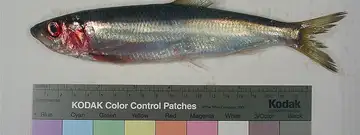
The Atlantic herring is a slim silver fish with a blue-green back that swims in dense schools of many thousands across the North Atlantic. It feeds on plankton and has been one of the most important food fish for centuries.
See it on the 3D globe →At a glance
- Class
- Fish
- Lives in
- North Atlantic and North Sea
- Diet
- Filter feeder
- Length
- about 0.3 m
- Conservation status
- Least Concern (IUCN LC)
- Habitat
- open ocean, coasts
Quick answers
Where does the Atlantic herring live?
It lives in open ocean, coasts of the Atlantic and Arctic oceans. On the globe you can find it near North Atlantic and North Sea.
How big is the Atlantic herring?
It grows to about 0.3 m.
What does the Atlantic herring eat?
Its diet: filter feeder.
Is the Atlantic herring endangered?
It is listed as Least Concern (IUCN LC).
The Atlantic herring is a slim silver fish with a blue-green back that lives on both sides of the North Atlantic. It is one of the most abundant fish species in the world. It grows up to 45 cm and 1.1 kg, and it feeds on copepods, krill and small fish. Seals, whales, cod and other big fish eat it.
It gathers in huge, dense schools, which makes it easy to catch near the coast. North Atlantic herring schools have been measured at up to 4 cubic kilometres, with an estimated four billion fish. For centuries the herring fishery has been important to the economy of New England and Atlantic Canada.
A fragile fish
Herring look tough but are fragile. They have large, delicate gill surfaces, and contact with foreign matter can strip away their big scales. They have left many river mouths because of pollution, but where water has been cleaned up, herring have come back. Their larvae are a sign of cleaner, oxygen-rich water.
A wide range
Atlantic herring school across the Gulf of Maine, the Gulf of St Lawrence, the Labrador Sea, the Norwegian Sea, the North Sea, the English Channel and the Bay of Biscay. Even though they live near the Arctic, they are not considered an Arctic species. In the North Sea, separate groups spawn at different times, such as the Buchan-Shetland herring in August and September.
From egg to Baltic herring
Herring mature at 3 to 5 years and can live another 12 to 16. A female releases between 20,000 and 40,000 sticky eggs that sink and stick to gravel or weed, and they hatch in one to three weeks depending on how warm the water is. The small, less fatty herring of the inner Baltic Sea are treated as a subspecies, the Baltic herring. It was voted the national fish of Estonia in 2007, and Helsinki has held an annual herring market since 1743.
Fun facts
- Herring swim in huge schools that can hold millions or even billions of fish.
- A single school was measured at up to 4 cubic kilometres.
- A school may hold an estimated four billion fish.
- Seals, whales and cod all eat herring.
- Herring larvae are a sign of cleaner water.
On the globe
The model shows a slim silver fish with a bluish-green back, as in the card. Imagine it swimming in a huge school.
Quiz time
Which is longer: Atlantic herring or Basking shark?
Show the answer
Basking shark. (0.3 m vs 7 m) Basking shark →
More like this
.jpg)
Sources
Updated: 2026-10-14