
Deep-sea anglerfish
초롱아귀(심해아귀)
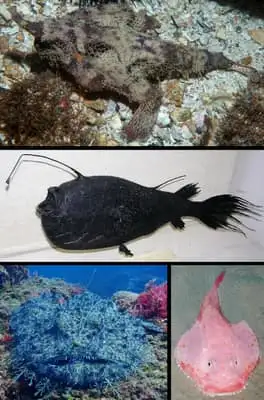
The deep-sea anglerfish lives in nearly lightless water and lures prey with a glowing lure on a rod above its head. The light comes from glowing bacteria. Males are much smaller, and in some species they fuse onto a female.
See it on the 3D globe →At a glance
- Class
- Fish
- Diet
- Meat eater (carnivore)
- Habitat
- deep sea
Quick answers
Where does the Deep-sea anglerfish live?
It lives in deep sea of the Pacific, Atlantic, Indian and Southern oceans.
What does the Deep-sea anglerfish eat?
Its diet: meat eater (carnivore).
Anglerfish are ray-finned fish of the order Lophiiformes. Their name comes from the way they hunt: a modified fin ray on the head acts as a lure, like a fishing rod. Anglerfish live in seas all over the world, from tropical to polar waters and from shallow places to the deep sea.
The deep-sea anglerfish lives in nearly lightless water and lures prey with a glowing lure on a rod above its head. The light comes from glowing bacteria, according to the card. Many species live on or near the seabed, including monkfishes, batfishes, frogfishes and sea toads. Some are of commercial value.
The lure
The tip of the lure is called the esca, and the whole rod is the illicium. Different species use different lures to attract the prey they eat.
Deep-sea anglerfish lack pelvic fins and drift in open water instead of resting on the sea floor, as many shallow relatives do. Both its common and scientific names come from this angling trick, and Lophiiformes refers to a crest-like lure.
Tiny males
Female and male deep-sea anglerfish are very different in size, and females can be many times heavier. In some species the small male attaches to the female and even fuses to her body. Scientists call this sexual parasitism.
Some relatives, the monkfish, are caught for their meat, which is considered a delicacy in many places. The size gap can be several orders of magnitude in weight.
Fun facts
- In some species, the tiny male fuses permanently onto the much larger female.
- The lure on the head is a modified fin ray.
- In some species the male fuses to the female.
- The glow of the lure comes from bacteria.
On the globe
The model shows a deep-sea anglerfish with a glowing lure. Look for the light on the stalk above the mouth.
More like this

Sources
Updated: 2026-10-14