
Basking shark
돌묵상어
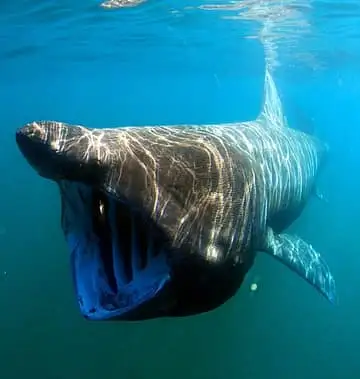
The basking shark grows to about 10 m, the second-largest fish after the whale shark. It cruises slowly with its huge mouth open, filtering plankton from thousands of tonnes of water each hour, and is harmless to people.
See it on the 3D globe →At a glance
- Class
- Fish
- Diet
- Filter feeder
- Length
- about 7 m
- Conservation status
- Endangered (IUCN EN)
- Habitat
- open ocean, coasts
Quick answers
Where does the Basking shark live?
It lives in open ocean, coasts of the Pacific, Atlantic and Indian oceans.
How big is the Basking shark?
It grows to about 7 m.
What does the Basking shark eat?
Its diet: filter feeder.
Is the Basking shark endangered?
It is listed as Endangered (IUCN EN).
The basking shark is the second-largest living shark and fish, after the whale shark. It usually reaches 7 to 8.5 metres, and some are 9 to 11 metres; the largest reliably recorded measured 12.27 metres, caught in a herring net in the Bay of Fundy in 1851. It is found worldwide in cool to warm temperate seas.
It is a slow filter feeder and one of only three plankton-eating sharks, along with the whale shark and the megamouth. Its name comes from its habit of feeding at the surface, as if it were basking in the sun. It has a huge mouth, up to 1 metre wide, and gill slits that almost circle its head. Despite its size and its frightening look, it is not aggressive and is harmless to people. Overfishing has reduced its numbers, and some populations have disappeared.
Feeding with a net
The basking shark swims with its mouth open at about 2 knots, letting water flow over dark, bristle-like gill rakers that catch plankton. In its mouth are about 100 tiny hooked teeth per row, but they are only 5 to 6 millimetres long and few are used. It does not suck in food, but relies on the water flowing in. It follows plankton, especially copepods, through the water, so it is often visible at the surface.
Travels and tricks
Basking sharks do not hibernate. They migrate with the seasons, and satellite tags have shown they travel thousands of kilometres in search of rich plankton. In winter they often go deeper, down to about 900 metres. They are big and slow, but they can leap entirely out of the water, perhaps to shake off parasites or to show off. Their liver can make up a quarter of their body weight and probably helps them float.
Mistaken identity
Basking sharks are sometimes mistaken for great white sharks, but the huge open mouth, long gill slits, small eyes and tiny teeth give them away. They have a keeled tail base and often show scars, perhaps from lampreys or cookiecutter sharks. Rotting basking shark bodies are the most likely explanation for several 'globsters', mysterious lumps washed ashore, such as the Stronsay Beast. For centuries the shark was hunted for its liver oil, meat and fins.
Fun facts
- It is the second-largest living fish after the whale shark and can filter about 2,000 tonnes of water an hour.
- It can filter hundreds of tonnes of water an hour.
- It can leap completely out of the water.
- Its liver may be a quarter of its body weight.
- Rotting basking sharks may explain some sea-monster carcasses.
On the globe
The model shows a huge shark with a wide-open mouth, as in the card. Look at the enormous mouth and gill slits.
Quiz time
Which is longer: Basking shark or Atlantic herring?
Show the answer
Basking shark. (7 m vs 0.3 m) Atlantic herring →
More like this

Sources
Updated: 2026-10-14