
Atlantic puffin
대서양퍼핀
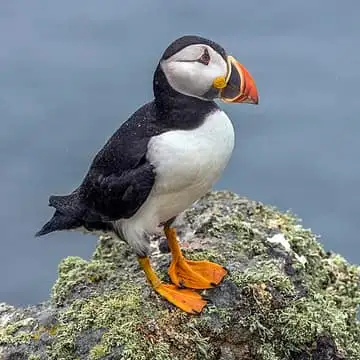
The Atlantic puffin is a seabird with a bright, colourful bill that is at its boldest in the summer breeding season. It swims underwater using its wings like paddles, and can carry more than ten small fish crosswise in its bill.
See it on the 3D globe →At a glance
- Class
- Birds
- Diet
- Fish eater
- Weight
- about 0.5 kg
- Length
- about 0.29 m
- Top speed
- about 88 km/h
- Lifespan
- up to about 41 years
- Conservation status
- Vulnerable (IUCN VU)
- Habitat
- coasts
Quick answers
Where does the Atlantic puffin live?
It lives in coasts of the Atlantic and Arctic oceans.
How big is the Atlantic puffin?
It grows to about 0.29 m and 0.5 kg.
What does the Atlantic puffin eat?
Its diet: fish eater.
How fast is the Atlantic puffin?
It can reach about 88 km/h.
How long does the Atlantic puffin live?
It can live up to about 41 years.
Is the Atlantic puffin endangered?
It is listed as Vulnerable (IUCN VU).
The Atlantic puffin (Fratercula arctica) is a small seabird with a big, colourful red-and-black beak. It has a black crown and back, grey cheeks, a white belly and orange legs. It is about 29 centimetres long, and it is the only puffin that lives in the Atlantic.
It spends autumn and winter far out on the cold northern sea and returns to coasts in spring to breed. It swims underwater by flapping its wings like paddles, and can carry more than ten small fish crosswise in its bill at one time. Because its numbers are falling in parts of its range, it is rated Vulnerable.
Colonies on cliffs
Puffins breed in places such as Iceland, Ireland, Britain, Norway, Greenland, Newfoundland and Labrador, the Faroe Islands, Maine and Brittany. They are most common in the Westman Islands of Iceland. Each pair digs a burrow on a clifftop and lays a single white egg. Colonies are usually on islands without land predators, though gulls and skuas attack from the air.
The clown of the sea
In winter, puffins moult at sea and lose some of the bright colours on the face, which return in spring. Chicks fledge after about six weeks and leave the burrow at night to swim out to sea. They do not return to land for several years. Because of its striking beak and waddling walk, the puffin is nicknamed the 'clown of the sea' or the 'sea parrot'.
Fun facts
- A puffin can carry a dozen or more small fish crosswise in its beak at once.
- A puffin can carry a dozen or more fish crosswise in its beak.
- Young puffins leave the burrow at night and stay at sea for years.
- Its bright beak colours fade in winter.
On the globe
The model shows an Atlantic puffin. Look for its colourful beak and orange feet.
Quiz time
Which is heavier: Atlantic puffin or Gyrfalcon?
Show the answer
Gyrfalcon. (0.5 kg vs 1.4 kg) Gyrfalcon →
More like this
.jpg)
Sources
Updated: 2026-10-14