
White stork
흰황새
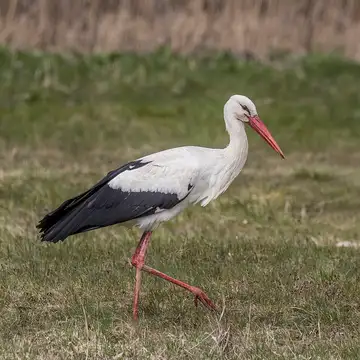
A white bird with black flight feathers and a long red bill and legs. It nests on rooftops and chimneys, and migrates thousands of kilometres to Africa each year.
See it on the 3D globe →At a glance
- Class
- Birds
- Lives in
- Plains of Poland
- Diet
- Meat eater (carnivore)
- Weight
- about 3.4 kg
- Length
- about 1.05 m
- Lifespan
- up to about 39 years
- Conservation status
- Least Concern (IUCN LC)
- Habitat
- wetlands, grasslands
Quick answers
Where does the White stork live?
It lives in wetlands, grasslands. On the globe you can find it near Plains of Poland.
How big is the White stork?
It grows to about 1.05 m and 3.4 kg.
What does the White stork eat?
Its diet: meat eater (carnivore).
How long does the White stork live?
It can live up to about 39 years.
Is the White stork endangered?
It is listed as Least Concern (IUCN LC).
The white stork is a large white bird with black flight feathers, a long red bill and long red legs. It is about 100 to 115 centimetres from bill to tail, with a wingspan of 155 to 215 centimetres. It is rated Least Concern.
It breeds across Europe, north-west Africa and parts of Asia, and winters in Africa or on the Indian subcontinent. Pairs build large stick nests, often on rooftops and chimneys, and may reuse them for several years. Its habit of nesting on buildings has made it a familiar friend of people in many European villages. It is also a lucky symbol in many cultures.
Big migrations
White storks soar on rising warm air called thermals, which do not form over water. So instead of crossing the Mediterranean, they detour via the Levant in the east or the Strait of Gibraltar in the west.
Each autumn they fly thousands of kilometres to Africa. The storks also have few natural predators, though their feathers can host lice and mites.
Nest and family
A pair is monogamous and lays one clutch of usually four eggs a year. The eggs hatch about 33 to 34 days later, and both parents take turns sitting and feeding. Chicks fly after 58 to 64 days.
They eat insects, fish, frogs, reptiles and small mammals. Farming changes caused declines, but conservation and reintroductions have brought them back to places like the Netherlands, Belgium, Switzerland, Sweden and the UK. Birds such as the white stork benefited when people cleared woods in the Middle Ages, but later farming changes caused declines.
Fun facts
- Each autumn they fly to Africa, crossing at Gibraltar or the Bosphorus to avoid long flights over open sea.
- They avoid flying over open sea because there is no rising warm air.
- Pairs reuse big stick nests for years.
- Chicks leave the nest after about two months.
On the globe
The model shows a white stork with black wing feathers, red bill and legs, standing on the plains of Poland.
Quiz time
Which is heavier: White stork or Mute swan?
Show the answer
Mute swan. (3.4 kg vs 10 kg) Mute swan →
More like this
_Bia%C5%82owieza.jpg)
Sources
Updated: 2026-10-14