
Rock ptarmigan
바위뇌조
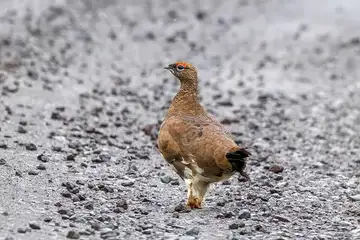
The rock ptarmigan (Lagopus muta) is a plump Arctic grouse that changes its feathers with the seasons. In winter it turns almost completely white, apart from black outer tail feathers and a black line through the eye. In spring and summer it moults to grey and brown, so it blends into the rocks and tundra.
See it on the 3D globe →At a glance
- Class
- Birds
- Lives in
- Svalbard
- Diet
- Plant eater (herbivore)
- Weight
- about 0.5 kg
- Length
- about 0.35 m
- Conservation status
- Least Concern (IUCN LC)
- Habitat
- polar regions, mountains
Quick answers
Where does the Rock ptarmigan live?
It lives in polar regions, mountains. On the globe you can find it near Svalbard.
How big is the Rock ptarmigan?
It grows to about 0.35 m and 0.5 kg.
What does the Rock ptarmigan eat?
Its diet: plant eater (herbivore).
Is the Rock ptarmigan endangered?
It is listed as Least Concern (IUCN LC).
An Arctic grouse that turns white in winter. Its feathered feet work like snowshoes, and it burrows into snow to shelter from the cold.
It is 34 to 36 centimetres long, weighs about 440 to 640 grams, and lives at high elevations and in cold, barren places in the Arctic and in mountains, including Svalbard. It is called just 'ptarmigan' in Europe. Feathers even cover its feet, so they work like snowshoes on the snow.
Names around the world
The genus name Lagopus comes from Greek words meaning 'hare foot', for its feathered legs. The word ptarmigan comes from the Gaelic tarmachan, meaning 'croaker', and the silent p was added by mistake. In the Inuit language of Nunavut it is called aqiggiq and is the territory's official bird. In Japan it is called raichō, 'thunder bird', and is the official bird of Gifu, Nagano and Toyama and is protected nationwide.
Built for the cold
The rock ptarmigan prefers higher, more barren ground than its cousin the willow ptarmigan, and it has a slimmer bill. To shelter from the cold, it can burrow into the snow. Scientists recognise 23 subspecies in different parts of the world, from the Aleutian Islands to the Alps. The species is rated Least Concern. It is about ten percent smaller than the willow ptarmigan.
Fun facts
- Its feathers turn white in winter and mottled brown in summer to match the ground.
- Its feet are covered in feathers like built-in snowshoes.
- In Japan its name raichō means 'thunder bird'.
- Its scientific name means 'hare foot' because of its feathered legs.
On the globe
The model shows a rock ptarmigan on Svalbard. Look for its white winter feathers and feathered feet.
Quiz time
Which is heavier: Rock ptarmigan or Western capercaillie?
Show the answer
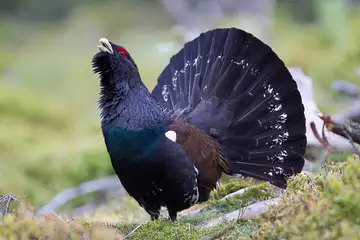
Western capercaillie. (0.5 kg vs 3.2 kg) Western capercaillie →
More like this
_female_breeding_Botnsvatn.jpg)
Sources
Updated: 2026-10-14