
Mute swan
혹고니
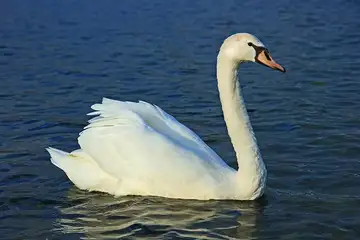
The mute swan (Cygnus olor) is a large, all-white swan with an orange bill edged in black. A bump called a knob sits above the bill and is bigger in males. It is native to much of Europe and parts of Asia, and a rare winter visitor to the far north of Africa. It has been introduced to North America, which now has the largest populations outside its native range, and to Australasia and southern Africa.
See it on the 3D globe →At a glance
- Class
- Birds
- Lives in
- Rivers and lakes of England
- Diet
- Plant eater (herbivore)
- Weight
- about 10 kg
- Length
- about 1.5 m
- Top speed
- about 88 km/h
- Lifespan
- up to about 40 years
- Conservation status
- Least Concern (IUCN LC)
- Habitat
- wetlands, rivers & lakes
Quick answers
Where does the Mute swan live?
It lives in wetlands, rivers & lakes. On the globe you can find it near Rivers and lakes of England.
How big is the Mute swan?
It grows to about 1.5 m and 10 kg.
What does the Mute swan eat?
Its diet: plant eater (herbivore).
How fast is the Mute swan?
It can reach about 88 km/h.
How long does the Mute swan live?
It can live up to about 40 years.
Is the Mute swan endangered?
It is listed as Least Concern (IUCN LC).
A white swan with an orange bill and black knob. In England it has long been tied to royal protection, and big males can exceed 10 kg.
It measures about 140 to 160 centimetres long with a wingspan of 200 to 240 centimetres, which makes it the second largest waterfowl on average, after the trumpeter swan. The name mute only means it is less noisy than other swans. It makes grunts, hoarse whistles and snorts, and it hisses when angry. It is one of the heaviest flying birds alive.
Big, heavy and fast
Males, called cobs, weigh about 10.6 to 11.9 kilograms on average in British studies, and females, called pens, about 8.5 to 9.7. One unusually big Polish cob weighed almost 23 kilograms, the largest weight verified for a flying bird, though people have asked whether it could still fly.
In flight a mute swan can reach up to 88.5 km/h, and on take-off it runs across the water at about 48 km/h to gain lift. Its legs are dark grey, and its feathers, especially on the head and neck, are often stained orange-brown by iron and tannins in the water.
Family life
Mute swans nest on big mounds of waterside plants, built in shallow water on islands or at a lake edge. They are monogamous and often reuse the same nest. A clutch is usually 5 to 8 eggs, the female sits for about 36 days, and the cygnets hatch between May and July.
Tired cygnets can climb onto a parent's back, and in heavy rain they shelter beneath a parent's wings. Cygnets are greyish and have a dull grey-black bill for the first year. Parents defend the nest fiercely, hissing first and then striking with the bony spurs in their wings.
A swan with surprising cousins
Though it belongs to the genus Cygnus, the mute swan's closest relatives are the black swan of Australia and the black-necked swan of South America, not the other northern swans. The German naturalist Johann Friedrich Gmelin named it in 1789, and cygnus and olor both mean swan in Latin.
Bones about 6,000 years old have been found in peat beds in East Anglia, England, and it has lived across Europe for a very long time. One colour form, the Polish swan, has pinkish legs and dull-white cygnets, and it appears only in populations with a history of domestication.
Fun facts
- Every July the swans on the River Thames are counted in a royal ceremony called 'Swan Upping'.
- Big males can weigh over 10 kilograms, and one record cob weighed almost 23 kg.
- Its closest cousins are the black swan and the black-necked swan.
- It can fly at up to 88.5 km/h.
- At Abbotsbury Swannery in southern England, a colony has more than 100 nesting pairs.
On the globe
The model shows a white mute swan with an orange bill and a black knob.
Quiz time
Which is heavier: Mute swan or Eurasian eagle-owl?
Show the answer
Mute swan. (10 kg vs 2.5 kg) Eurasian eagle-owl →
More like this


Sources
Updated: 2026-10-14