
Beluga whale
흰고래(벨루가)
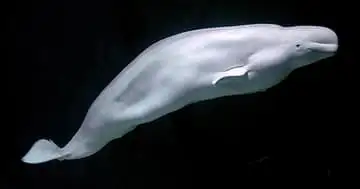
A white Arctic whale about 4 to 5 m long. It makes so many whistles, clicks and chirps that it is called the "canary of the sea", and unlike most whales it can turn its head freely because its neck bones are not fused.
See it on the 3D globe →At a glance
- Class
- Mammals
- Diet
- Fish eater
- Weight
- about 1,000 kg
- Length
- about 4 m
- Top speed
- about 22 km/h
- Lifespan
- up to about 80 years
- Conservation status
- Least Concern (IUCN LC)
- Habitat
- polar regions, coasts
Quick answers
Where does the Beluga whale live?
It lives in polar regions, coasts of the Arctic, Pacific and Atlantic oceans.
How big is the Beluga whale?
It grows to about 4 m and 1,000 kg.
What does the Beluga whale eat?
Its diet: fish eater.
How fast is the Beluga whale?
It can reach about 22 km/h.
How long does the Beluga whale live?
It can live up to about 80 years.
Is the Beluga whale endangered?
It is listed as Least Concern (IUCN LC).
The beluga, or white whale, is a small whale of the Arctic and sub-Arctic. Most live in the Arctic Ocean and the seas and coasts around North America, Russia and Greenland. Adults are pure white and can reach about 5.5 metres long, and their worldwide population is thought to be around 200,000.
Belugas are nicknamed sea canaries because they make so many high-pitched whistles, clicks and chirps. They have no back fin, which helps them swim under sea ice, and a round bump on the forehead called the melon that they use for echolocation. Their sense of hearing is highly developed, and their echolocation helps them move about and find food.
Life around the ice
Most belugas spend the winter near the Arctic ice. When the ice melts in summer they move to river mouths and shallow coastal waters, where hundreds or even thousands may gather. Groups usually number about ten. Belugas swim slowly but can dive to around 700 metres, and they use echolocation to find breathing holes in the ice. Native peoples of North America and Russia have hunted belugas for many centuries. Belugas are opportunistic feeders, so what they eat depends on the place and the season.
Body and name
Males can weigh up to 1,600 kilograms, and a thick layer of blubber keeps the body warm. The name comes from the Russian word for white. Its closest relative is the narwhal, and these two are the only living members of their family. The melon on the head is large and can change shape. Because blubber makes up a large share of the whole body weight, the whale stays warm in icy water. Its body size lies between that of a dolphin and a True's beaked whale.
Fun facts
- Belugas are nicknamed "sea canaries" because of their many whistles, clicks and chirps.
- Belugas are called the canaries of the sea because of their chirps and whistles.
- With no dorsal fin, a beluga can glide under sheet ice more easily.
- The only close relative of the beluga is the narwhal.
On the globe
The model shows a white whale with a rounded forehead and no back fin. Look for it in cold northern waters.
Quiz time
Which is heavier: Beluga whale or Canada lynx?
Show the answer
Beluga whale. (1,000 kg vs 9.5 kg) Canada lynx →
More like this




Sources
Updated: 2026-10-14