
Whale shark
고래상어
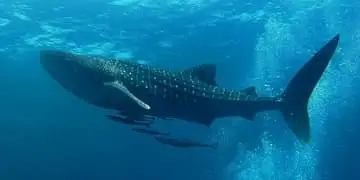
The biggest fish in the world, growing past 12 m long, yet it feeds by filtering tiny plankton through its enormous mouth. Its spot pattern is unique to each shark, like a fingerprint, so researchers can tell individuals apart.
See it on the 3D globe →At a glance
- Class
- Fish
- Lives in
- Central Indian Ocean
- Diet
- Filter feeder
- Length
- about 10 m
- Top speed
- about 5 km/h
- Lifespan
- up to about 70 years
- Conservation status
- Endangered (IUCN EN)
- Habitat
- open ocean, coasts, coral reefs
Quick answers
Where does the Whale shark live?
It lives in open ocean, coasts, coral reefs of the Pacific, Atlantic and Indian oceans. On the globe you can find it near Central Indian Ocean.
How big is the Whale shark?
It grows to about 10 m.
What does the Whale shark eat?
Its diet: filter feeder.
How fast is the Whale shark?
It can reach about 5 km/h.
How long does the Whale shark live?
It can live up to about 70 years.
Is the Whale shark endangered?
It is listed as Endangered (IUCN EN).
The whale shark is the biggest fish in the world. Most adults are about 5.5 to 10 metres long, and the largest one reliably measured was 18.8 metres, longer than a city bus. Despite its name, it is a shark, not a whale; it got the name because it is as huge as some whales and, like many of them, it eats tiny food by filtering seawater. It lives in warm tropical seas all around the world, in the Atlantic, Pacific and Indian Oceans.
Whale sharks are gentle and slow-moving, and they are not dangerous to people, so divers and snorkellers can swim alongside them. Each one has its own pattern of pale spots and stripes on its dark back, a bit like a fingerprint. Sadly, their numbers have fallen by more than half over the last 75 years, and they are now listed as Endangered.
What it eats
A whale shark eats some of the smallest food in the sea: plankton, krill, fish eggs, jellyfish and little schooling fish such as sardines and anchovies. It swims with its huge mouth open, up to about 1.2 metres wide, and sieves the water through spongy filter pads in its gills. It can process more than 6,000 litres of water an hour. When food is very thick, it may hang upright near the surface and gulp. Although it has about 300 rows of tiny teeth in each jaw, it does not use them to eat, and its throat is only about as wide as a coin.
Where it lives
Whale sharks prefer warm water, usually above 21 °C. They are great travellers that cover thousands of kilometres across tropical oceans following seasonal food. At certain times of year many gather at feeding spots, such as Ningaloo Reef in Western Australia, where the coral spawns, and the coast of Mexico's Yucatán Peninsula. They spend most of their time in the top 200 metres of the ocean, but they also make deep dives; the deepest ever recorded was 1,928 metres.
Is it endangered?
Yes. The IUCN Red List lists the whale shark as Endangered. The main dangers are fishing, getting caught by accident in nets meant for other fish, and being struck by large ships, because whale sharks often feed slowly at the surface. They also grow up slowly; males may not be ready to breed until around 25 years old, so lost sharks are hard to replace. Scientists use photos of each shark's spots to count and track them.
Fun facts
- Its spot pattern is unique to each shark, so researchers can identify individuals from photos.
- A whale shark's skin can be about 10 centimetres thick, as tough as strong rubber.
- One female whale shark was found carrying about 300 babies at once; the pups hatch from eggs inside the mother and are born about half a metre long.
- Whale sharks may live a very long time: scientists estimate their lifespan at roughly 70 years or more, with some studies suggesting over 100.
- Even their eyeballs are protected by tiny tooth-like scales, and they can pull their eyes back into their sockets.
On the globe
The model shows a whale shark, the world's biggest fish, cruising in the central Indian Ocean. Zoom in to look for the pale spots on its back and its wide, flat mouth.
Quiz time
Which is longer: Whale shark or Blacktip reef shark?
Show the answer
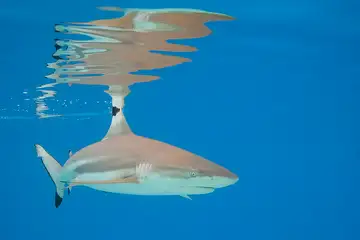
Whale shark. (10 m vs 1.6 m) Blacktip reef shark →
More like this

Sources
- Read more on Wikipedia
- Whale shark — Wikipedia
- 고래상어 — 위키백과
- Whale Shark — National Geographic
- Whale Shark — Georgia Aquarium
Updated: 2026-10-13