
Blue whale
대왕고래
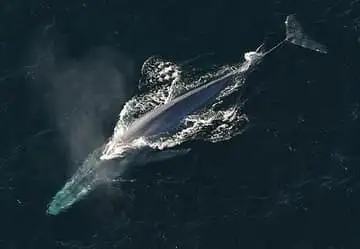
The blue whale is the largest animal that has ever lived, nearly 30 m long and over 100 tonnes. It has no teeth, filtering tiny krill through baleen, and eats several tonnes a day. Its heart alone weighs about 180 kg, the biggest of any animal.
See it on the 3D globe →At a glance
- Class
- Mammals
- Lives in
- Eastern Pacific Ocean
- Diet
- Filter feeder
- Weight
- about 100,000 kg
- Length
- about 25 m
- Top speed
- about 50 km/h
- Lifespan
- up to about 90 years
- Conservation status
- Endangered (IUCN EN)
- Habitat
- open ocean
Quick answers
Where does the Blue whale live?
It lives in the open ocean of the Pacific, Atlantic, Indian and Southern oceans. On the globe you can find it near Eastern Pacific Ocean.
How big is the Blue whale?
It grows to about 25 m and 100,000 kg.
What does the Blue whale eat?
Its diet: filter feeder.
How fast is the Blue whale?
It can reach about 50 km/h.
How long does the Blue whale live?
It can live up to about 90 years.
Is the Blue whale endangered?
It is listed as Endangered (IUCN EN).
The blue whale is the largest animal known to have ever lived, bigger than any dinosaur. The longest ones measured reach about 30 metres, and the heaviest weigh around 190 to 200 tonnes. Blue whales swim in every ocean except the Arctic. Their mottled blue-grey skin looks light blue under the water, which is how they got their name.
Blue whales were once common, but whalers hunted them almost to extinction in the early 1900s. The International Whaling Commission banned all blue whale hunting in 1966, and their numbers are now slowly growing, but they are still listed as Endangered. Today the main dangers are being hit by ships, getting tangled in fishing gear, ocean noise and climate change. Scientists think blue whales can live around 80 to 90 years.
What does it eat?
The biggest animal on Earth eats some of the smallest: krill, tiny shrimp-like animals. A blue whale has no teeth. Instead, it has baleen plates hanging from its upper jaw that work like a giant sieve. It lunges at a swarm of krill with its mouth open, gulping a huge amount of water as its pleated throat stretches like a balloon. Then it pushes the water out with its tongue, and the krill stay trapped behind the baleen. The biggest blue whales may eat up to about 6 tonnes of krill in a day.
Amazing body
The heart of a blue whale that washed ashore in the North Atlantic weighed about 180 kilograms, the largest heart known in any animal. During deep dives, a blue whale's heart can slow to only about two beats a minute. Blue whales also make some of the loudest and lowest sounds of any animal, reaching about 188 decibels. Many of their calls are too low for people to hear, and in the right conditions other whales may hear them hundreds of kilometres away.
Family life
Blue whales are usually seen alone or in pairs, and the strongest bond is between a mother and her calf. Many blue whales spend summer feeding in cold polar waters and swim toward warmer waters in winter, where calves are born. A mother is pregnant for 10 to 12 months. Her newborn calf is already about 6 to 7 metres long and weighs 2 to 3 tonnes, and it grows fast on its mother's rich milk. The Gulf of California in Mexico is one place where mothers and young calves are often seen.
Fun facts
- Its calls are among the loudest sounds made by any animal.
- The blue whale is the largest animal known to have ever lived, even bigger than the largest dinosaurs.
- A newborn blue whale calf is about 6 to 7 metres long, longer than a car.
- A blue whale's heart can beat as slowly as about two times a minute on a deep dive.
- Scientists can estimate a whale's age by counting layers in its waxy earplug, like rings in a tree.
- Blue whales eat mostly krill, animals only a few centimetres long.
On the globe
The model shows a blue whale swimming in the eastern Pacific Ocean. Look for its long, slender body moving through the sea.
Quiz time
Which is heavier: Blue whale or Gray whale?
Show the answer
Blue whale. (100,000 kg vs 27,000 kg) Gray whale →
More like this

Sources
Updated: 2026-10-13