
Asiatic cheetah
아시아치타
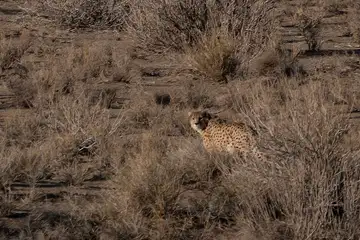
A very rare subspecies of cheetah living on the Iranian plateau. It is a little smaller and paler than its African cousin, with long legs and black tear lines. Only a few dozen at most survive, almost all in Iran.
See it on the 3D globe →At a glance
- Class
- Mammals
- Lives in
- Central Iran (Yazd and Semnan provinces)
- Diet
- Meat eater (carnivore)
- Top speed
- about 100 km/h
- Conservation status
- Critically Endangered (IUCN CR)
- Habitat
- deserts, grasslands
Quick answers
Where does the Asiatic cheetah live?
It lives in deserts, grasslands. On the globe you can find it near Central Iran (Yazd and Semnan provinces).
What does the Asiatic cheetah eat?
Its diet: meat eater (carnivore).
How fast is the Asiatic cheetah?
It can reach about 100 km/h.
Is the Asiatic cheetah endangered?
It is listed as Critically Endangered (IUCN CR).
The Asiatic cheetah is a critically endangered subspecies of cheetah. Today it survives only in Iran, in protected areas on the central plateau. Long ago it roamed from the Arabian Peninsula and the Near East to the Caspian region and northern South Asia, but it vanished from those places during the 20th century.
It diverged from the African cheetahs between 32,000 and 67,000 years ago. In December 2017, fewer than 50 were thought to remain, in three groups scattered over 140,000 square kilometres of Iran's central plateau. Like all cheetahs it belongs to the fastest land animal species in the world.
How many are left?
In the 1970s about 200 Asiatic cheetahs lived in 11 protected areas of Iran. By the end of the 1990s only 50 to 100 were thought to remain. Between 2001 and 2012 camera traps across 18 reserves identified 82 individuals, but 42 died during those years through poaching, road accidents and natural causes. Because the survivors live in a few scattered groups, each loss matters.
A cheetah of the desert
The Asiatic cheetah has buff to light fawn fur with small black spots, and black stripes on the tail tip. Its coat and mane are shorter than those of African cheetahs. An adult measures about 112 to 135 cm from head to body, with a tail of 66 to 84 cm, and weighs 34 to 54 kg. It lives in open desert around Dasht-e Kavir in eastern Iran, and most animals are found in five protected areas, including Kavir National Park and Bafq Protected Area.
How was it named?
The first scientific name, Felis venatica, was proposed by Edward Griffith in 1821 from a sketch of a cheetah without a mane in India. In 1913 Max Hilzheimer named a Central Asian population Acinonyx raddei, from a specimen collected in Merv, Turkmenistan. A five-year genetic study found that Iran's cheetahs are the last representatives of the Asiatic subspecies.
Fun facts
- Fewer than 50 are thought to survive, all in Iran.
- It split from African cheetahs 32,000 to 67,000 years ago.
- Cheetahs are the fastest land animals.
- Camera traps identified 82 individuals in just two years.
On the globe
The model shows a slim, pale cheetah with black tear lines, as in the card. Look for the long legs.
Quiz time
Which is faster: Asiatic cheetah or Lion?
Show the answer
Asiatic cheetah. (100 km/h vs 80 km/h) Lion →
More like this



Sources
Updated: 2026-10-14