
Meerkat
미어캣
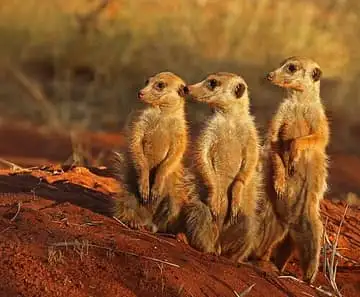
Some members of the group stand tall on their hind legs as sentries, watching for predators. Meerkats live in underground burrows in mobs of up to about 30, eat insects and even scorpions, and give different alarm calls for different dangers.
See it on the 3D globe →At a glance
- Class
- Mammals
- Lives in
- Kalahari Desert, southern Africa
- Diet
- Insect eater
- Weight
- about 0.8 kg
- Length
- about 0.5 m
- Top speed
- about 32 km/h
- Lifespan
- up to about 14 years
- Conservation status
- Least Concern (IUCN LC)
- Habitat
- deserts, savannas, grasslands
Quick answers
Where does the Meerkat live?
It lives in deserts, savannas, grasslands. On the globe you can find it near Kalahari Desert, southern Africa.
How big is the Meerkat?
It grows to about 0.5 m and 0.8 kg.
What does the Meerkat eat?
Its diet: insect eater.
How fast is the Meerkat?
It can reach about 32 km/h.
How long does the Meerkat live?
It can live up to about 14 years.
Is the Meerkat endangered?
It is listed as Least Concern (IUCN LC).
The meerkat, also called the suricate, is a small mongoose from southern Africa. It has a broad head, big eyes, a pointed snout and a coat with faint light and dark stripes. It lives in dry, open country in places such as Botswana, Namibia and South Africa.
Meerkats live in groups called packs or mobs of two to about 30, and every pack member has a job. While some animals search for food, others stand tall on their back legs as lookouts and call out when a danger appears. That teamwork made meerkats famous, including as Timon in a well-known animated film. A pack's home range covers about 5 square kilometres, and the group moves between burrow systems as it searches for food. They are social animals that live in a clear hierarchy.
Life in the burrow
A meerkat pack lives in a large underground network of tunnels, usually with around 15 entrances and two or three levels. Burrows stay much milder than the weather outside, which helps in a harsh desert climate. Meerkats are active by day, mostly early in the morning and late in the afternoon, and dash underground when they sense trouble. Meerkats can regulate their body temperature to cope with the desert, and the cool burrow gives them a place to rest when the weather is extreme.
Food and family
Meerkats mainly eat insects such as beetles and caterpillars, but they also take other small animals, including reptiles and small birds, and some plants. Their front claws are made for digging. Usually the dominant animals in a pack have the babies, while other members help look after the pups. A litter has three to seven pups. Pups are born all year round, with peaks after heavy rain. A pregnancy lasts 60 to 70 days, and helpers share the work of feeding and guarding the young.
Fun facts
- While the group feeds, one or more meerkats stand guard and call out alarms when predators appear.
- A meerkat weighs only about 0.6 to 1 kilogram, less than a bag of sugar.
- Meerkats use many different calls, including calls that warn the pack about a predator.
- A pack's home territory covers around 5 square kilometres.
On the globe
The model shows meerkats in their sentry pose, standing tall on their hind legs to keep watch.
Quiz time
Which is heavier: Meerkat or Cheetah?
Show the answer
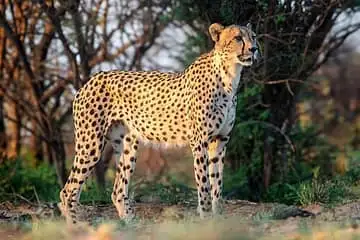
Cheetah. (0.8 kg vs 45 kg) Cheetah →
More like this
_Tswalu.jpg)
Sources
Updated: 2026-10-14