
Chimpanzee
침팬지
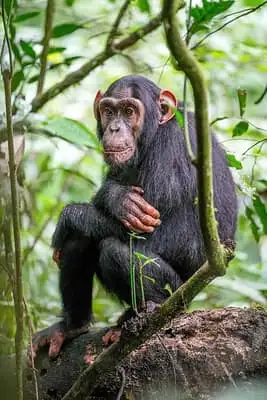
Our closest living relative, which uses stones as hammers to crack open nuts. Its DNA is about 98% the same as ours, and in Taï forest young chimps learn this skill by watching their mothers.
See it on the 3D globe →At a glance
- Class
- Mammals
- Lives in
- Taï National Park, Côte d'Ivoire
- Diet
- Eats both plants and meat (omnivore)
- Weight
- about 45 kg
- Length
- about 1.2 m
- Top speed
- about 40 km/h
- Lifespan
- up to about 60 years
- Conservation status
- Endangered (IUCN EN)
- Habitat
- rainforests, forests, savannas
Quick answers
Where does the Chimpanzee live?
It lives in rainforests, forests, savannas. On the globe you can find it near Taï National Park, Côte d'Ivoire.
How big is the Chimpanzee?
It grows to about 1.2 m and 45 kg.
What does the Chimpanzee eat?
Its diet: eats both plants and meat (omnivore).
How fast is the Chimpanzee?
It can reach about 40 km/h.
How long does the Chimpanzee live?
It can live up to about 60 years.
Is the Chimpanzee endangered?
It is listed as Endangered (IUCN EN).
The chimpanzee is a great ape, not a monkey, that lives in the forests and savannas of equatorial Africa. Together with its cousin the bonobo, it is the closest living relative of humans: when matching stretches of chimp and human DNA are compared, they differ by only about one and a half percent. Chimps are covered in coarse black hair, but their faces, fingers, palms and the soles of their feet are bare.
Chimpanzees are clever, social animals. They live in communities that can have more than 200 members, talk to each other with calls, faces and gestures, and use tools more than almost any other animal. Sadly, they are endangered. Scientists estimate that roughly 170,000 to 300,000 remain in the wild, down from around a million in the early 1900s, mainly because of forest loss, hunting and disease.
Where it lives
Chimpanzees are found across a belt of Africa near the equator, from West Africa to Tanzania. They can live in many kinds of places: rainforests, mountain forests, swamp forests, dry woodlands and grassy savannas. Scientists recognise four subspecies, or local types. The chimps of Taï National Park in Côte d'Ivoire belong to the western group. Every evening a chimp bends branches together high in a tree to make a fresh sleeping nest, which it usually uses for just one night.
What it eats
Chimpanzees mostly eat fruit, especially ripe figs, but they also munch leaves, seeds, flowers, bark and insects, and they use sticks to get honey. Sometimes they hunt small animals, most often red colobus monkeys. In Taï forest, a hunting group splits into roles like a team: some chimps drive the monkeys in one direction, others block their escape, some chase, and others wait in ambush. After a successful hunt, the meat is shared with the hunters and even with chimps who were only watching.
Clever tool users
In 1960 the researcher Jane Goodall saw a chimp in Gombe, Tanzania, trim a twig and poke it into a termite mound to fish out termites. It was the first time a non-human animal had been reported making a tool. In West Africa, chimps crack hard nuts by placing them on a flat stone or root, called an anvil, and hitting them with a stone or wooden hammer. Taï chimps choose their hammers carefully, thinking about weight, material and hardness, and how far they would have to carry them. Nut cracking is hard to learn, and in Taï the skill is passed from mothers to their young, who learn it by watching closely for years.
Fun facts
- Chimpanzees and bonobos are our closest living relatives, sharing about 98–99% of our DNA.
- Chimps drum on the trunks of big trees with their hands and feet to send signals.
- Archaeologists have found stone tools used by chimpanzees about 4,300 years ago.
- Chimps have been seen crushing insects and putting them on their own wounds and on the wounds of other chimps.
- In the wild, an adult male chimp weighs about 40 kilograms and a female about 30 kilograms.
- A newborn chimp clings to its mother about 80 percent of the time, and it drinks her milk until it is about three years old.
On the globe
The model shows a chimpanzee in Taï National Park, Côte d'Ivoire, where chimps use stones as hammers to crack open nuts. Zoom in on West Africa to find it.
Quiz time
Which is heavier: Chimpanzee or Pygmy hippopotamus?
Show the answer
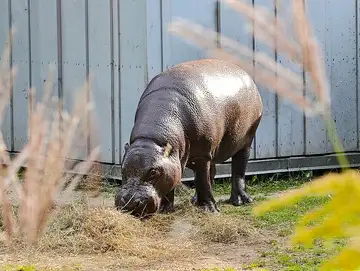
Pygmy hippopotamus. (45 kg vs 230 kg) Pygmy hippopotamus →
More like this

Sources
- Read more on Wikipedia
- Chimpanzee — Wikipedia
- 침팬지 — 위키백과
- Cracking the case: chimpanzees choose nut-cracking tools — Max Planck Institute for Evolutionary Anthropology
Updated: 2026-10-13