
Greater bilby
빌비
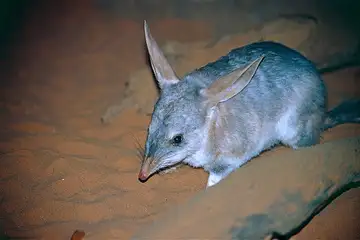
The greater bilby is a rabbit-eared marsupial of the Australian deserts. It digs long burrows, feeds at night on insects and seeds, and is a threatened species that conservation programmes are working to protect.
See it on the 3D globe →At a glance
- Class
- Mammals
- Lives in
- Central and Western Australian deserts
- Diet
- Eats both plants and meat (omnivore)
- Weight
- about 1.4 kg
- Conservation status
- Vulnerable (IUCN VU)
- Habitat
- deserts, grasslands
Quick answers
Where does the Greater bilby live?
It lives in deserts, grasslands. On the globe you can find it near Central and Western Australian deserts.
How big is the Greater bilby?
It grows to about 1.4 kg.
What does the Greater bilby eat?
Its diet: eats both plants and meat (omnivore).
Is the Greater bilby endangered?
It is listed as Vulnerable (IUCN VU).
The greater bilby is a rabbit-eared marsupial of the Australian deserts. It belongs to a group called bilbies, or rabbit-bandicoots. When Europeans arrived in Australia there were two species, but the lesser bilby died out in the 1950s, and the greater bilby survives as a vulnerable species.
A greater bilby is about 55 centimetres long, plus a tail of about 29 centimetres. Its grey or white fur, long pointed nose and very long ears are its trademarks. Conservation programmes are working to protect it. It is a member of the order Peramelemorphia, along with bandicoots. It is mainly active at night.
What does its name mean?
The word bilby is borrowed from the Yuwaalaraay language of northern New South Wales, where it means long-nosed rat. In Western Australia it is called dalgite, and in South Australia people sometimes say pinkie. The scientific name Macrotis is Greek for big-eared. Those long burrows help the bilby avoid hot days. At night it sniffs out food in the sand using its sensitive nose, and its big ears help it hear danger.
Life in the desert
Bilbies are omnivores, so they eat both plants and small animals. They dig long burrows to shelter from the heat and feed at night on insects and seeds. Because their numbers have fallen, rangers and scientists protect them and run breeding and release programmes. Foxes, cats and changes in the land have all hurt bilbies, so many are now kept in protected areas. Their survival depends on keeping their desert habitat safe and free of invasive predators.
Fun facts
- In Australia, chocolate Easter Bilbies are sold instead of Easter bunnies to help protect this endangered animal.
- The bilby's name comes from an Aboriginal language, Yuwaalaraay.
- The lesser bilby went extinct in the 1950s.
- Its scientific name Macrotis means 'big-eared'.
On the globe
The model shows a bilby with its big ears and long nose. Look for it in the Australian desert.
Quiz time
Which is heavier: Greater bilby or Red kangaroo?
Show the answer
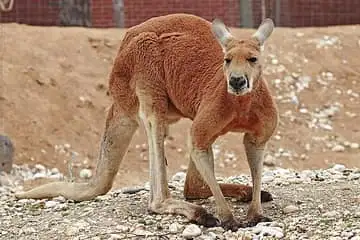
Red kangaroo. (1.4 kg vs 50 kg) Red kangaroo →
More like this

_(9996143106).jpg)
Sources
Updated: 2026-10-14