
Great barracuda
그레이트 바라쿠다
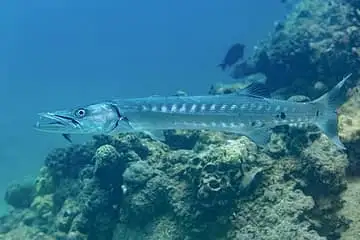
The great barracuda is a long, streamlined tropical predator with a mouth full of sharp teeth, reaching about 1.5 m. It can dash at roughly 50 km/h over short distances to snatch fish, and is often drawn to shiny objects.
See it on the 3D globe →At a glance
- Class
- Fish
- Diet
- Fish eater
- Weight
- about 6 kg
- Length
- about 0.8 m
- Top speed
- about 58 km/h
- Lifespan
- up to about 14 years
- Conservation status
- Least Concern (IUCN LC)
- Habitat
- coral reefs, coasts
Quick answers
Where does the Great barracuda live?
It lives in coral reefs, coasts of the Atlantic, Pacific and Indian oceans.
How big is the Great barracuda?
It grows to about 0.8 m and 6 kg.
What does the Great barracuda eat?
Its diet: fish eater.
How fast is the Great barracuda?
It can reach about 58 km/h.
How long does the Great barracuda live?
It can live up to about 14 years.
Is the Great barracuda endangered?
It is listed as Least Concern (IUCN LC).
The great barracuda is a large, long, silvery predator of warm seas around the world. It lives in tropical to warm temperate waters of the Indian, Pacific and Atlantic oceans, from mangroves and seagrass beds out to deep reefs, down to about 110 metres. It is the largest of the 27 barracuda species.
Its body is long and slim, with a big pointed head like a pike's, a lower jaw that juts out and unequal fang-like teeth. It is blue-grey on top, fading to silver and chalky white underneath, and sometimes has dark bars or blotches. Most adults are 60 to 100 cm long and weigh 2.5 to 9 kg, but exceptional ones pass 1.5 metres and 23 kg. The largest great barracuda was said to measure 3 metres.
How it hunts
The great barracuda is an ambush hunter. It relies on surprise and short bursts of speed of up to about 58 km/h, and it gives up some agility for that speed. Small prey is swallowed in one bite. With bigger prey it shakes its head from side to side to break the meal into pieces. Fish such as herrings, sardines and anchovies make up nearly all its diet, with some squid and occasional shrimp.
Young and old
Young and half-grown fish often gather in schools, while large adults are mostly solitary. Juveniles and small adults stay near shore in mangroves and seagrass, and adults are found farther out around reefs, rocks and man-made structures. The spawning season runs from April to October, and a female can release about 5,000 to 30,000 eggs. Barracudas can live at least 14 years.
Barracudas and people
Barracuda attacks on people are rare. They are curious and may follow snorkelers hoping to snap up the leftovers of their prey, and a flash of bright metal can look like a small fish to them. Their strong fight makes them popular with anglers. Eating the meat carries a risk of ciguatera fish poisoning. In Florida, great barracudas are reported to be declining, and catch limits are being considered.
Fun facts
- Young barracudas often swim in schools, but large adults usually hunt alone.
- It can burst forward at up to about 58 km/h.
- Young barracudas swim in schools, but large adults usually hunt alone.
- The largest great barracuda was said to be 3 metres long.
- Shiny objects can look like prey to a barracuda.
On the globe
The model shows a long, silvery fish with a pointed head and strong jaws, as in the card. Look at the lower jaw and fangs.
Quiz time
Which is heavier: Great barracuda or Tiger shark?
Show the answer
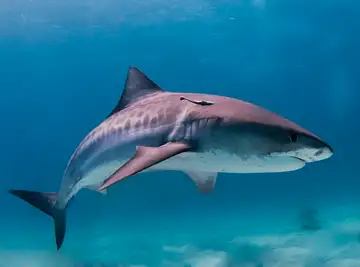
Tiger shark. (6 kg vs 500 kg) Tiger shark →
More like this
,_Yeda,_Arabia_Saudita,_2025-05-20,_DD_118.jpg)
Sources
Updated: 2026-10-14