
Emu
에뮤
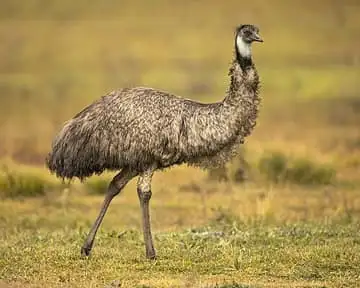
Australia's largest bird; it cannot fly but can sprint at about 50 km/h. Standing around 1.5 m tall, it has an unusual family routine: the male sits on the dark green eggs for about two months, barely eating at all.
See it on the 3D globe →At a glance
- Class
- Birds
- Lives in
- Inland Western Australia
- Diet
- Eats both plants and meat (omnivore)
- Weight
- about 35 kg
- Top speed
- about 50 km/h
- Lifespan
- up to about 30 years
- Conservation status
- Least Concern (IUCN LC)
- Habitat
- grasslands, savannas, deserts, forests
Quick answers
Where does the Emu live?
It lives in grasslands, savannas, deserts, forests. On the globe you can find it near Inland Western Australia.
How big is the Emu?
It grows to about 35 kg.
What does the Emu eat?
Its diet: eats both plants and meat (omnivore).
How fast is the Emu?
It can reach about 50 km/h.
How long does the Emu live?
It can live up to about 30 years.
Is the Emu endangered?
It is listed as Least Concern (IUCN LC).
The emu is a flightless bird found only in Australia, where it is the tallest native bird. It is the second-tallest bird in the world after the ostrich, and the largest can reach 150 to 190 centimetres. It has soft brown feathers, a long neck and long legs, and its wings are so tiny that they are hard to see among the plumage.
Emus are strong runners. They can travel long distances and sprint at about 48 km/h when they need to. They eat a variety of plants and insects and can go for weeks without food. They drink rarely, but take in a lot of fresh water when they can. Adults weigh between 18 and 60 kg. The emu is sufficiently common to be rated least concern by the IUCN, although the island subspecies on Tasmania, Kangaroo Island and King Island became extinct after Europeans arrived in 1788.
The dads do the nesting
Breeding takes place in May and June, and females often fight for a mate. A female may mate several times and lay several clutches in one season. The male incubates the eggs. While he does, he hardly eats or drinks and loses a lot of weight. After about eight weeks the chicks hatch and are looked after by their father. They reach full size after around six months but may stay together as a family until the next breeding season.
A national symbol
The emu is a famous cultural icon of Australia, and appears on the country's coat of arms and on several coins. It also features strongly in Indigenous Australian stories. Its name is uncertain, but may come from an Arabic word for a large bird or a Portuguese word for an ostrich-like bird. Some of its Aboriginal names are barrimal, myoure and courn in Victoria, and murawung or birabayin around Sydney.
Numbers and dangers
The mainland emu is still common, and its population changes from decade to decade, mostly with rainfall. In 2009 it was estimated at between 630,000 and 725,000 birds. Eggs are eaten by other animals, particularly invasive species, and the birds are also threatened by roadkill and habitat fragmentation. Some local populations are listed as endangered. Emus were brought to Kangaroo Island in the 20th century, and those birds have established a breeding population.
Fun facts
- The male emu sits on the eggs for about eight weeks, barely eating or drinking.
- It is the tallest bird native to Australia.
- It can sprint at about 48 km/h.
- The father sits on the eggs for about eight weeks.
- It appears on Australia's coat of arms.
On the globe
The model shows a big flightless bird with a long neck and shaggy brown feathers, as in the card. Look at the shaggy feathers.
Quiz time
Which is heavier: Emu or Black swan?
Show the answer
Emu. (35 kg vs 6 kg) Black swan →
More like this

Sources
Updated: 2026-10-14