
Laughing kookaburra
웃는물총새
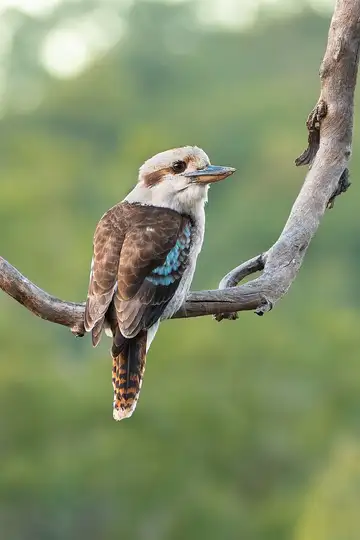
The largest kingfisher, famous for its laughing call. It has a big head, a thick bill and a brown eye stripe. It watches from a tree and catches lizards and snakes.
See it on the 3D globe →At a glance
- Class
- Birds
- Lives in
- Southeastern Australian woodland
- Diet
- Meat eater (carnivore)
- Weight
- about 0.33 kg
- Length
- about 0.42 m
- Lifespan
- up to about 20 years
- Conservation status
- Least Concern (IUCN LC)
- Habitat
- forests, towns & cities
Quick answers
Where does the Laughing kookaburra live?
It lives in forests, towns & cities. On the globe you can find it near Southeastern Australian woodland.
How big is the Laughing kookaburra?
It grows to about 0.42 m and 0.33 kg.
What does the Laughing kookaburra eat?
Its diet: meat eater (carnivore).
How long does the Laughing kookaburra live?
It can live up to about 20 years.
Is the Laughing kookaburra endangered?
It is listed as Least Concern (IUCN LC).
The laughing kookaburra, Dacelo novaeguineae, is the largest kingfisher, even heavier than the giant kingfisher. It is a stout bird 41 to 47 centimetres long with a big head, a long strong bill, a whitish head with a dark brown eye-stripe, dark brown upperparts, and a tail barred with rufous and black. Males and females look much alike, though the female is usually a little larger.
It is native to eastern mainland Australia and has been introduced to Tasmania, Western Australia and parts of New Zealand. It lives in dry eucalypt forest, woodland, parks and gardens. It stays in the same territory all year and keeps the same partner for life. The IUCN rates it Least Concern because it has a large range and population. Its famous laugh is often used as a jungle sound effect in films.
The famous laugh
The laugh is a territorial call that tells neighbouring groups where the border is. It can be heard at any time but mostly at dawn and dusk. One bird starts with a low hiccup, throws its head back, and others join in; if a rival family answers, everyone gathers and fills the bush with sound.
A special two-part voice box lets it make two pitches at once. The call is learned: parents teach fledglings, and the lessons last about two weeks. The old name was laughing jackass, recorded in 1798.
A helpful family
Pairs breed in unlined tree holes or holes dug into termite nests. The female lays about three white eggs at roughly two-day intervals, and both parents and helpers incubate them for 24 to 26 days. Up to five grown young from earlier years help defend the territory and feed the chicks.
The chicks fledge at 32 to 40 days. Chicks have a hook on the upper bill, and when food is short they may quarrel, and the smallest one can be killed by its siblings. When food is plentiful, parents spend more time brooding and the fighting does not happen.
A patient hunter
Like other kingfishers, the kookaburra perches on a branch or wire, waits for prey to pass, then swoops down and pounces. It eats mice, insects, earthworms, snails, small fish, lizards, frogs and small birds, and most famously snakes. It sometimes takes goldfish from garden ponds.
It occasionally catches large animals, including venomous snakes much longer than its body. The first scientific record was a 1776 account by Pierre Sonnerat, who wrongly said the bird came from New Guinea. That mistake is why the species name is novaeguineae.
Fun facts
- Its loud call sounds like human laughter and is often used as a "jungle" sound in films.
- It is the largest kingfisher of all.
- A kookaburra can make two sounds at the same time with its voice box.
- Young kookaburras must learn to laugh from their parents.
- The species name says New Guinea only because of a mistake made in 1776.
On the globe
Look in southeastern Australian woodland; the card shows its big head and thick bill.
Quiz time
Which is heavier: Laughing kookaburra or Rainbow lorikeet?
Show the answer
Laughing kookaburra. (0.33 kg vs 0.12 kg) Rainbow lorikeet →
More like this

Sources
Updated: 2026-10-14