
Gelada
겔라다
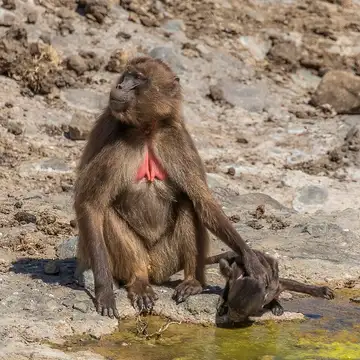
A primate of the Ethiopian Highlands, nicknamed the bleeding-heart monkey for the red patch of bare skin on its chest. It is the only living primate that feeds mainly on grass and gathers in herds of hundreds.
See it on the 3D globe →At a glance
- Class
- Mammals
- Lives in
- Cliffs and grasslands of the Ethiopian Highlands
- Diet
- Plant eater (herbivore)
- Weight
- about 15 kg
- Conservation status
- Least Concern (IUCN LC)
- Habitat
- mountains, grasslands
Quick answers
Where does the Gelada live?
It lives in mountains, grasslands. On the globe you can find it near Cliffs and grasslands of the Ethiopian Highlands.
How big is the Gelada?
It grows to about 15 kg.
What does the Gelada eat?
Its diet: plant eater (herbivore).
Is the Gelada endangered?
It is listed as Least Concern (IUCN LC).
The gelada is a monkey that lives only in the Ethiopian Highlands, at heights of 1,800 to 4,400 metres above sea level. It is sometimes called the bleeding-heart monkey because adult males have a bright red, hourglass-shaped patch of skin on the chest. Females have a bare patch too, but it is less striking.
Geladas spend much of their time on the ground, and they are the only living primates that live mainly on grass, which can make up as much as 90 percent of their diet. They have buff to dark brown hair, a dark face and pale eyelids. Males weigh about 18.5 kilograms on average and females about 11. They live in large, well-organised groups.
A big, layered society
Gelada society has several levels. The two basic groups are reproductive units and male units. When a reproductive unit has more than one male, only one of them mates with the females. Many units form a band, and one to four bands make up a community. Females in a unit are usually close relatives. Young males leave the group where they were born to try to take over a unit of their own, and the females can choose whether to support or oppose the newcomer. Geladas also use many different calls, and scientists think their range of sounds comes close to the complexity of human speech.
Are geladas in danger?
Their number is thought to have dropped from 440,000 in the 1970s to 200,000 in 2008. Even after such a big loss, the IUCN lists the species as Least Concern. Geladas are the only living member of the genus Theropithecus, a name that comes from Greek words meaning 'beast-ape'. Larger relatives lived in Africa, Europe and Asia in the past, and fossils have been found in many countries.
Fun facts
- It is the only primate that lives mainly on grass, and males have a bright red 'bleeding heart' patch on the chest.
- Grass can make up as much as 90 percent of a gelada's diet.
- Their calls are thought to be nearly as complex as human speech.
- The name of their genus means 'beast-ape' in Greek.
On the globe
The toy model of the gelada sits on the cliffs and grasslands of the Ethiopian Highlands. Look for the red patch on the chest.
Quiz time
Which is heavier: Gelada or Somali wild ass?
Show the answer
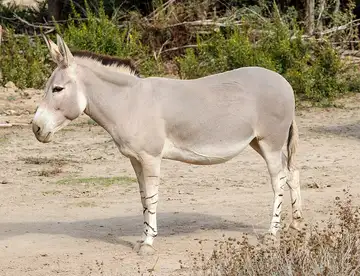
Somali wild ass. (15 kg vs 250 kg) Somali wild ass →
More like this
_female_with_baby.jpg)
Sources
Updated: 2026-10-14