
Somali wild ass
소말리야생당나귀
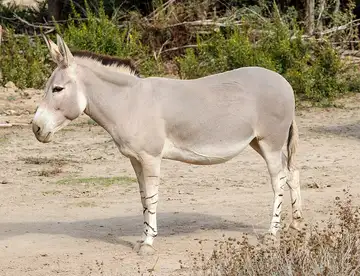
A subspecies of the African wild ass, ancestor of the domestic donkey, with zebra-like black stripes on its legs. It lives in waterless arid country, and only a few hundred remain in the wild.
See it on the 3D globe →At a glance
- Class
- Mammals
- Lives in
- Arid lands of Eritrea, Ethiopia and Somalia
- Diet
- Plant eater (herbivore)
- Weight
- about 250 kg
- Conservation status
- Critically Endangered (IUCN CR)
- Habitat
- deserts
Quick answers
Where does the Somali wild ass live?
It lives in deserts. On the globe you can find it near Arid lands of Eritrea, Ethiopia and Somalia.
How big is the Somali wild ass?
It grows to about 250 kg.
What does the Somali wild ass eat?
Its diet: plant eater (herbivore).
Is the Somali wild ass endangered?
It is listed as Critically Endangered (IUCN CR).
The Somali wild ass (Equus africanus somaliensis) is a subspecies of the African wild ass. Its legs are striped, just like those of its relatives the zebras. It lives in Somalia, Somaliland, the southern Red Sea region of Eritrea and the Afar Region of Ethiopia, in dry country with few resources.
The IUCN describes it as critically endangered, facing an extremely high risk of extinction in the wild. About 600 are estimated to live in the wild, plus about 200 in zoos around the world. It is among the rarest wild horses and asses on Earth. Donkeys in Italy descend from the Somali wild ass since Roman times, while donkeys elsewhere in Europe mostly descend from the Nubian wild ass.
A fission-fusion society
Because its habitat has so few resources, the Somali wild ass lives in what scientists call a fission-fusion society. Most adults live alone, but females and their young sometimes form small herds. Where rain brings more food, bigger temporary herds can gather.
Stallions hold territories as large as about nine square miles, roughly 23 square kilometres, and leave dung piles as markers of the borders. Females are welcome, but stallions often fight other males who try to mate with them. Some stallions have been seen letting a male graze, as long as he shows no interest in the females.
Growing up fast
Foals are usually born in spring after a pregnancy of about a year. Within hours, a foal is on its feet and keeping up with its mother. At about five days old it is already nibbling grass, and by two weeks it grazes regularly, though it still depends on milk for fluids.
The foal is weaned at 12 to 14 months but stays close to its mother, leaving only to play or feed with other foals in the herd.
Zoo help and safe places
The leading zoo for the Somali wild ass is Zoo Basel in Switzerland. It started keeping them in 1970, had its first birth in 1972, and has coordinated the European breeding programme and the global species committee since 2004. All Somali wild asses in captivity are related to the original group at Zoo Basel.
A protected group lives in Israel's Yotvata Hai-Bar Nature Reserve, established in 1968 to build up populations of endangered desert species. Before 2014 a project in Eritrea, mainly supported by Zoo Basel, counted 47 wild animals in the mountains between the Buri Peninsula and the Dallol Depression.
Fun facts
- The African wild ass is the wild ancestor of the donkey; the Somali kind has zebra-like stripes on its legs.
- Its striped legs look like a zebra's.
- Some Italian donkeys have descended from it since Roman times.
- A foal can stand within hours of birth.
- All captive animals descend from the Zoo Basel group.
On the globe
The toy model shows a Somali wild ass in the dry lands of Eritrea, Ethiopia and Somalia.
Quiz time
Which is heavier: Somali wild ass or Spotted hyena?
Show the answer
Somali wild ass. (250 kg vs 50 kg) Spotted hyena →
More like this

Sources
Updated: 2026-10-14