
Fiji crested iguana
피지이구아나
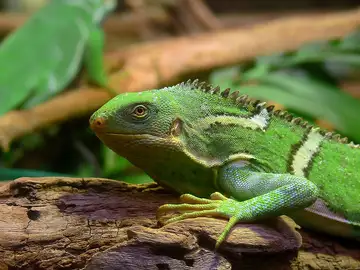
The Fiji crested iguana lives only on a few islands in Fiji's dry forests. Males are bright green with pale bands and a crest of spines along the back. It was described in 1981 and is critically endangered.
See it on the 3D globe →At a glance
- Class
- Reptiles
- Lives in
- Dry forests of Fiji
- Diet
- Plant eater (herbivore)
- Length
- about 0.7 m
- Conservation status
- Critically Endangered (IUCN CR)
- Habitat
- forests
Quick answers
Where does the Fiji crested iguana live?
It lives in forests. On the globe you can find it near Dry forests of Fiji.
How big is the Fiji crested iguana?
It grows to about 0.7 m.
What does the Fiji crested iguana eat?
Its diet: plant eater (herbivore).
Is the Fiji crested iguana endangered?
It is listed as Critically Endangered (IUCN CR).
The Fiji crested iguana is a critically endangered lizard found only on a few small islands in northwestern Fiji, in dry forest. It is a large, stocky iguana with a row of short spines along its back from the neck to the tail. Males have three narrow cream or white bands, and the lizard can grow to 75 cm long and weigh up to 300 grams.
It was described by scientists only in 1981. Its discovery was helped by the 1980 film The Blue Lagoon, which was filmed on a remote Fijian island. A herpetologist, John Gibbons, had found the iguana on a different island, but only when a colleague spotted the same lizard in the film did people realise how widely it lived. The iguana can quickly change from green to black when it is alarmed, and it eats mostly leaves, fruit and flowers.
A lizard that crossed an ocean
The Fiji crested iguana and its relatives, the Lau banded iguana and the Fiji banded iguana, belong to a genus called Brachylophus. Scientists think their ancestors rafted about 9,000 km west across the Pacific from the Americas, where their closest relatives live today. The genus name means 'short crest' in Greek. Hatchlings are dark green at first, but after a few hours they turn bright emerald green with narrow white bands, and have reddish-orange eyes.
Behaviour and food
The iguana is active by day and lives in the shade of trees, seeking sun on cool days. It climbs from tree to tree through overlapping branches, and its long toes and tail help it balance. When threatened it goes from bright green to dark green, and if things get extreme, black. If that does not scare off a predator, it puffs out its neck, bobs its head and lunges. It eats leaves, fruit, shoots and flowers, and especially likes the sweet flowers of the vau tree.
Saving a rare lizard
The species is restricted to rain-shadow dry forest, one of the most threatened kinds of vegetation in the Pacific. Most of the iguanas, fewer than 4,000, live on Yadua Taba, a reserve where goats have been removed and forest burning banned. Goats brought to Yadua Taba in 1972 had stripped the plants, and the dry forest has since recovered. Rats, mongooses and cats are other dangers. Females lay about four eggs, which take 8 to 9 months to hatch.
Fun facts
- It was described only in 1981, partly thanks to a film.
- Its ancestors may have rafted 9,000 km across the Pacific.
- It can change from green to black when scared.
- Eggs take 8 to 9 months to hatch.
On the globe
The model shows a green crested iguana with pale bands, as in the card. Look at the spiny crest.
Quiz time
Which is longer: Fiji crested iguana or Tuatara?
Show the answer
Fiji crested iguana. (0.7 m vs 0.5 m) Tuatara →
More like this

Sources
Updated: 2026-10-14