
Fin whale
참고래
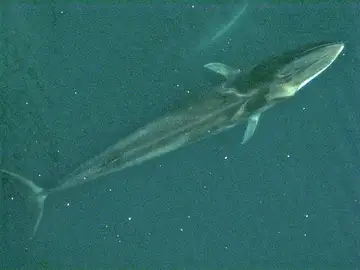
The fin whale is the second-largest animal on Earth, about 20 to 25 m long. Its slim grey body and small dorsal fin let it swim at nearly 40 km/h, which has earned it the nickname "greyhound of the sea".
See it on the 3D globe →At a glance
- Class
- Mammals
- Lives in
- Oceans worldwide, incl. the Mediterranean
- Diet
- Filter feeder
- Weight
- about 40,000 kg
- Length
- about 21 m
- Top speed
- about 40 km/h
- Lifespan
- up to about 90 years
- Conservation status
- Vulnerable (IUCN VU)
- Habitat
- open ocean
Quick answers
Where does the Fin whale live?
It lives in the open ocean of the Pacific, Atlantic, Indian, Arctic and Southern oceans. On the globe you can find it near Oceans worldwide, incl. the Mediterranean.
How big is the Fin whale?
It grows to about 21 m and 40,000 kg.
What does the Fin whale eat?
Its diet: filter feeder.
How fast is the Fin whale?
It can reach about 40 km/h.
How long does the Fin whale live?
It can live up to about 90 years.
Is the Fin whale endangered?
It is listed as Vulnerable (IUCN VU).
The fin whale is the second-longest animal on Earth after the blue whale. The biggest individuals reportedly measured 26 to 27.3 metres, and adults usually weigh 36 to 45 tonnes. Its body is long, slender and brownish-grey, with a paler underside that makes it less visible from below. It lives in all the major oceans, from polar to tropical waters, and is most common in temperate and cool seas.
Fin whales are baleen whales that filter food from the water, mainly krill, copepods, small schooling fish and squid. They are among the fastest of the great whales. They normally cruise at 37 to 41 km/h, and bursts of 46 to 50 km/h have been recorded, which earned the whale its nickname 'the greyhound of the sea'. It has two blowholes that can send a spout 4 to 6 metres into the air. The IUCN lists it as vulnerable.
Whaling and recovery
Fin whales were prized by whalers, and more than 725,000 were reportedly taken from the Southern Hemisphere between 1905 and 1976. By 2010, numbers of the southern fin whale were predicted to be below half of what they were before whaling. In the North Atlantic, fin whales are considered fully recovered, while elsewhere recovery is still going on. As of 2018 the IUCN assessed the species as vulnerable.
Food and voices
Their diet varies by place. In the North Pacific, most whales examined in past whaling studies had eaten only krill. In the North Atlantic, they eat krill and small fish such as capelin. Fin whales are often seen in pods of 6 to 10 animals and talk to each other with sounds at 16 to 40 hertz, much lower than people can usually hear. Like other rorquals, it has grooves running from the tip of the lower jaw to the navel.
Growing up
Mating happens in winter in warm, low-latitude water, and a pregnancy lasts 11 to 12 months. A calf is 6 to 6.5 metres long at birth. At 6 to 7 months old, when it is already 11 to 12 metres, it stops drinking its mother's milk. Calves stay with their mothers for around a year. Fin whales can live a long time: some caught off Iceland were 65 to 82 years old, and a female found in 2010 was estimated at 135 to 140 years.
Fun facts
- The second-largest animal on Earth after the blue whale, it is nicknamed the 'greyhound of the sea' for its speed.
- It is nicknamed the greyhound of the sea.
- A calf is already 6 metres long at birth.
- Its blow can shoot 4 to 6 metres high.
- One female was estimated to be 135 to 140 years old.
On the globe
The model shows a huge, slender whale with a pale underside, as in the card. Look at the long body and the throat grooves.
Quiz time
Which is heavier: Fin whale or Alpine ibex?
Show the answer
Fin whale. (40,000 kg vs 65 kg) Alpine ibex →
More like this

Sources
Updated: 2026-10-14