
Alpine ibex
알프스아이벡스
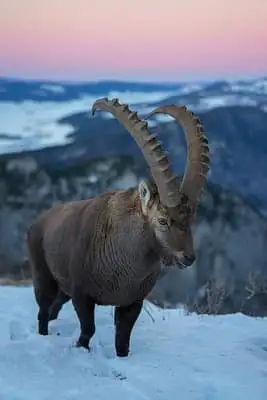
A wild goat with huge back-curving horns that climbs near-vertical cliffs and even dam walls. By the 1800s only about 100 survived in Italy's Gran Paradiso, but protection let them spread across the Alps again.
See it on the 3D globe →At a glance
- Class
- Mammals
- Lives in
- Alpi Marittime Natural Park, Italy
- Diet
- Plant eater (herbivore)
- Weight
- about 65 kg
- Conservation status
- Least Concern (IUCN LC)
- Habitat
- mountains
Quick answers
Where does the Alpine ibex live?
It lives in mountains. On the globe you can find it near Alpi Marittime Natural Park, Italy.
How big is the Alpine ibex?
It grows to about 65 kg.
What does the Alpine ibex eat?
Its diet: plant eater (herbivore).
Is the Alpine ibex endangered?
It is listed as Least Concern (IUCN LC).
The Alpine ibex is a wild goat that lives in the Alps. Males have huge back-curving horns, much bigger than the females'. It lives on steep, rough slopes and open mountain meadows up to about 3,300 m, and its sharp hooves help it climb cliffs.
In the 19th century hunters nearly wiped it out and fewer than 100 survived, all in Gran Paradiso National Park in Italy. Protection and reintroductions helped it spread again, and today it is listed as Least Concern. The Alpine ibex is also known as the steinbock. Its coat is brownish-grey, and it feeds mostly on grass.
A mountain climber
Alpine ibexes feed mainly on grass and stay active all year. The card says they climb near-vertical cliffs, even dam walls.
Outside the mating season, males and females live apart. In the breeding season males use their long horns to fight for females. Males are much larger than females and carry much longer horns. Ibexes have few predators, though parasites and diseases can harm them.
A comeback story
By the early 1800s only about 100 were left, in Italy's Gran Paradiso area, and all Alpine ibex today descend from them. Because of this, genetic diversity is very low.
The species was first described by Linnaeus in 1758. Its name steinbock is German, and in Latin the species name means chamois. Despite this, the species has been successfully reintroduced to parts of its historical range.
Fun facts
- All living Alpine ibex descend from about 100 animals.
- Ibexes can live as high as 3,300 m.
- Males and females spend most of the year apart.
On the globe
The model shows an Alpine ibex with its long curved horns. Look at the horns and the sturdy legs made for cliffs.
Quiz time
Which is heavier: Alpine ibex or Fin whale?
Show the answer
Fin whale. (65 kg vs 40,000 kg) Fin whale →
More like this

Sources
Updated: 2026-10-14